
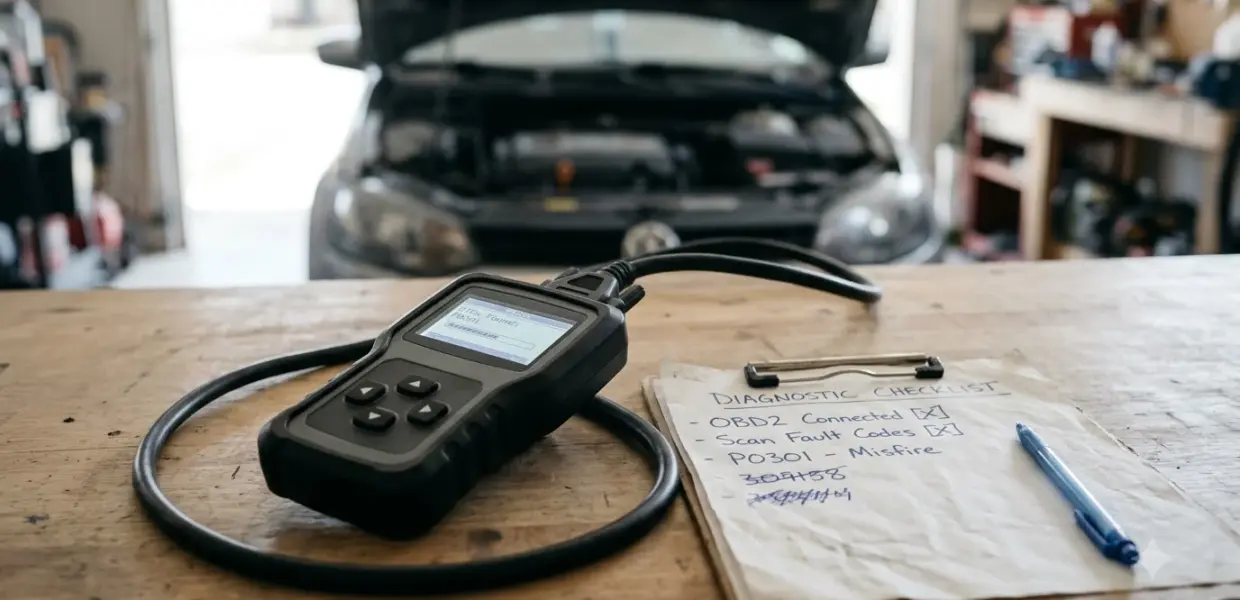

Learning how to test a fuel injector takes four checks: listen for clicks, measure coil resistance, confirm the power and pulse signals, and inspect the spray pattern. Each check tells you something different about the injector’s health.
If you want to know how to test a fuel injector at home, start with the listening and multimeter checks because they are quick and cost nothing. Move to pressure or spray testing only when those results point to a faulty injector.
Signs of a Failing Fuel Injector
A failing fuel injector usually causes a rough idle, hesitation under load, or a misfire code such as P030X. Those symptoms do not prove the injector is bad, so testing comes first.
Common warning signs include the following. Each one has other possible causes, so treat them as reasons to test, not as a diagnosis. Treat the list as a checklist, since a test only confirms what these symptoms suggest.
- Rough or uneven idle
- Hesitation or stumbling during acceleration
- A misfire code such as P030X, or a flashing check engine light
- Lower fuel economy than usual, without a clear reason
A misfire code points to a cylinder that is not burning fuel correctly (see our guide to engine misfire causes). Ignition parts and vacuum leaks can cause the same symptoms, so a code alone does not name the injector.
If you are new to how to test a fuel injector, match the test to the symptom first. A misfire on one cylinder points to that cylinder’s injector, wiring, or ignition parts, while a rough idle across all cylinders calls for a broader check of fuel delivery.
Tools and Safety Before You Start
You need a digital multimeter with an ohms setting, a test light, and a long metal rod or screwdriver. Every method for how to test a fuel injector needs the same basics, and you should work on a cool engine in a ventilated area, away from sparks and open flame.
- Digital multimeter with ohms and volts settings (here is how to use an automotive multimeter)
- Test light or low-current voltmeter
- Long metal rod or screwdriver with a flat tip
- Fuel pressure gauge, optional, for the valve test (see how to use a fuel pressure tester)
- Vehicle service manual for the exact resistance spec
Fuel vapor is flammable. Wear gloves and eye protection, keep a fire extinguisher nearby, and avoid any spark near the fuel rail.
Gather the tools first, because how to test a fuel injector goes faster when every probe and meter is ready.
How to Test a Fuel Injector by Listening for Clicks
With the engine running, a healthy injector makes a steady clicking sound you can hear through a long metal rod. Silence, or clicks that sound different from the others, points to a fault.
This is the fastest way to test a fuel injector without a meter, so it makes a sensible first screen.
- Start the engine and let it idle.
- Touch the tip of the metal rod to the top of one injector.
- Put your ear to the other end of the handle and listen for a regular clicking.
- Repeat on every injector and compare the sounds.
A click does not prove the injector sprays correctly. It only shows the solenoid is cycling, so keep testing if the symptoms continue.
Many owners stop here because the sound is easy to hear, but a clicking injector can still leak or spray poorly. That is why the rest of how to test a fuel injector matters.
How to Test a Fuel Injector with a Multimeter
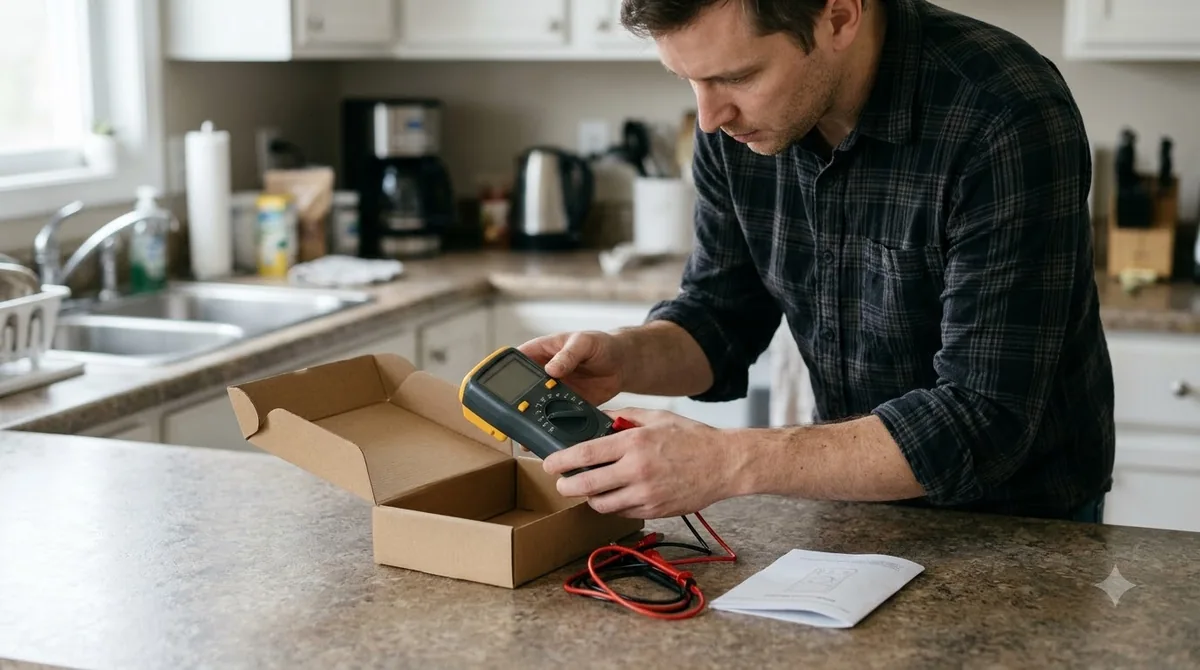
Disconnect the injector and read its coil resistance with the key off. Many injectors measure about 11 to 14 ohms when cold, but the service manual for your vehicle has the final word.
Let the engine cool, turn the key off, and unplug the injector connector. Set the multimeter to ohms and touch one probe to each injector terminal. Read the number, then compare it with the spec. The same steps apply whenever you learn how to test a fuel injector on a new vehicle.
2CarPros’ fuel injector test guide notes that a typical coil reads about 11 to 14 ohms when cold. Specs vary by make, model and injector type, so do not condemn an injector on a rough guess.
| Reading | What it suggests |
|---|---|
| Within the manual’s range and close to the other injectors | Coil is likely sound; move on to the signal checks |
| Outside the manual’s range | Replace the injector |
| No reading at all, which means an open circuit | Broken coil; replace the injector |
| Reading far below the manual’s range | Out of range; replace the injector |
Compare every injector on the engine. One reading that differs from the rest tells you more than a single number checked in isolation.
Write down each reading with its cylinder number so you can compare them later.
Checking Power and Ground Signals
With the key on, one wire at the injector connector should read about 12 volts. During cranking, a test light on the other side should flicker with engine speed.
- Turn the key on, not the engine. Probe both sides of the injector connector with a voltmeter or test light referenced to battery negative.
- One wire should show about 12 volts. If neither wire does, check the injector fuse first.
- Connect the test light to battery positive. Crank or start the engine and probe the other terminal.
- The light should flicker with engine speed and load. No pulse with the engine running points to wiring or a failed computer driver.
A healthy signal does not prove the valve opens, so the power check works as a filter rather than a final answer. A missing pulse needs a wiring check before you buy a new injector.
Electrical checks are quick and narrow the cause before you condemn the part. They are one piece of how to test a fuel injector, not the whole job.
Fuel Pressure and Leak Checks
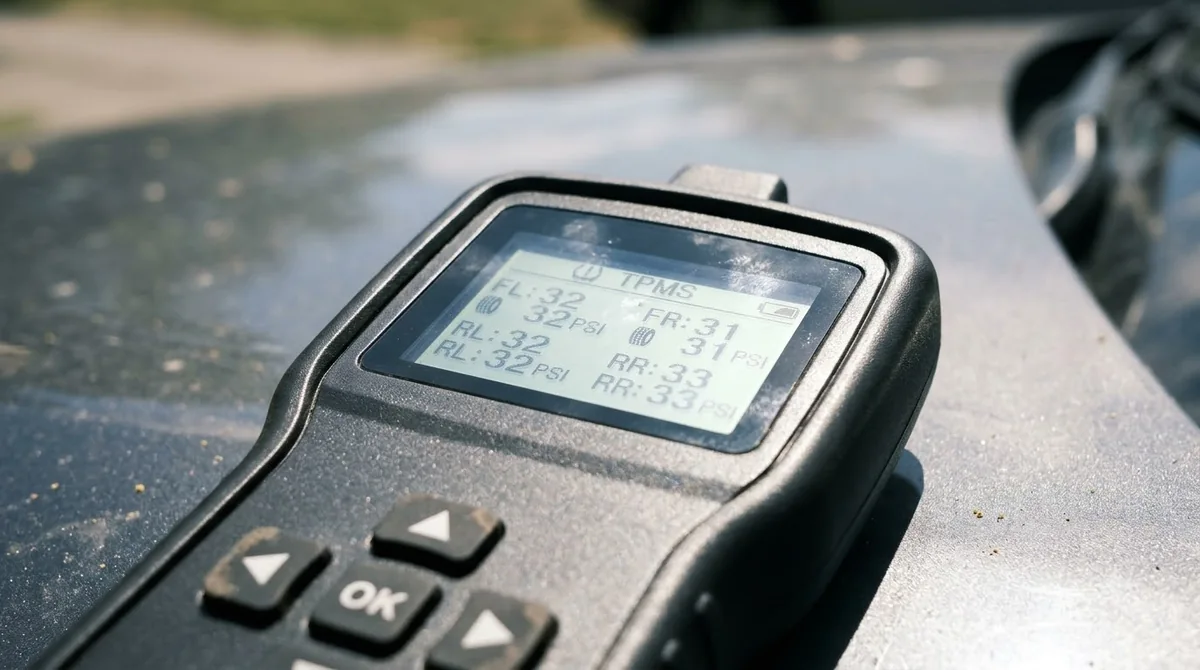
A fuel pressure gauge shows whether the injector valve opens and closes. With the gauge connected and the pump energized, cycle the injector and watch the needle. Use this step when the electrical checks pass but the engine still misfires, because it is where how to test a fuel injector looks at valve action.
A needle that fluctuates with each cycle suggests normal valve action. A needle that stays steady suggests the valve is not responding, and the injector is the likely suspect.
Hyundai’s GDI injector leak bulletin shows a leak check in practice. The technician monitors fuel pressure with the engine running, then after shutdown, and replaces the affected injectors if pressure drops.
That bulletin applies only to certain 2021 to 2023 Hyundai Sonata and Tucson, 2021 to 2022 Santa Fe and 2022 Santa Cruz models with the 2.5L non-turbo GDI engine, within the stated VIN and production ranges. Do not apply it to other vehicles, and check your own service manual for a pressure spec.
Without a manufacturer spec for your engine, a pressure drop cannot be judged by number alone. Use the gauge only with the fuel line setup your service manual describes, since the test depends on safe, correct connections. If the engine still runs rough after the injector checks, our guide on how to test a PCV valve covers another simple check.
Spray Pattern and Bench Testing
A removed injector should release a fine, cone-shaped mist when energized with 12 volts and pressurized air. A weak, muted, or solid stream means the injector should be replaced.
Remove the injector and apply pressurized air to the inlet. Energize it with 12 volts and watch the spray. An uneven or muted pattern points to a clogged or worn tip.
Bench testing adds time and needs a fuel-safe setup, so most owners stop at the earlier checks unless the symptoms persist. Catch any fuel in a container and keep the work area clear of heat. Knowing how to test a fuel injector on the bench is useful, but most readers do not need that step.
Bench testing is the most direct look at spray quality, and it gives the clearest answer on how to test a fuel injector beyond the electrical checks.
Frequently Asked Questions
Can a bad fuel injector cause a misfire?
Yes. A faulty injector can cause a misfire, and the engine often stores a P030X code when that happens. The code alone does not name the injector, so test each one before replacing it.
What is the normal resistance of a fuel injector?
Many injectors read about 11 to 14 ohms when cold, according to 2CarPros. Your service manual gives the exact range for your make, model and injector type, and that number takes priority.
Do I need to remove the injector to test it?
No. The listening test, the resistance check and the power checks all work on an installed injector. Only the spray pattern test requires removal. Knowing how to test a fuel injector in place saves time on most vehicles.
Does a good resistance reading mean the injector works?
Not always. Internal clogging or a poor spray pattern can still cause misfires, so a good ohm reading does not rule out a fault. Use the pressure or spray checks when symptoms continue. If the injectors test well, check fuel delivery next with our fuel pump testing guide. That is the final step in how to test a fuel injector when the earlier checks look normal.
Is it safe to test fuel injectors at home?
It can be, with care, and the same caution applies whenever you follow how to test a fuel injector at home. Fuel vapor is flammable, so work in a ventilated area, avoid sparks, and wear gloves and eye protection. If you are not comfortable with the fuel system, ask a shop to run the checks.
Can a scan tool test a fuel injector?
A scan tool reads trouble codes and sometimes live data, but it cannot measure coil resistance or spray quality. For a full answer on how to test a fuel injector, combine a multimeter check with the signal and spray checks above.
Replace an injector only after the signal checks pass, the resistance falls outside the manual’s range, or the pressure or spray results confirm a fault. Testing first keeps you from buying a part the engine does not need (our fuel injector cleaner guide covers the cleaning option), and a clear plan for how to test a fuel injector makes that easier.
