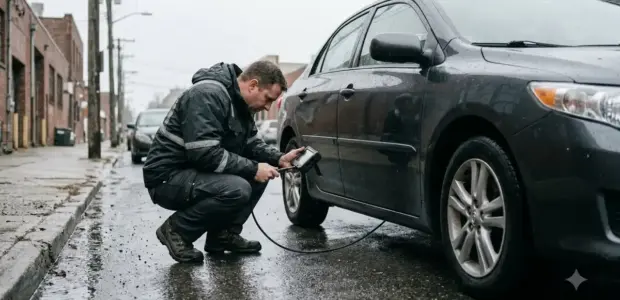

Knowing how to use a fuel pressure gauge lets you check whether the fuel pump and regulator deliver enough pressure to the engine. You connect the gauge to the fuel system test port, run the pump, and read the pressure at idle.
Both the Innova and Matco manuals start with the same rule: relieve system pressure before the gauge touches the fuel system. The service manual for your car gives the pressure it should show.
Fuel systems stay under pressure, and gasoline is flammable. Follow your vehicle’s service manual, and ask a qualified shop if any step is unclear.
What a Fuel Pressure Gauge Tells You
A fuel pressure gauge shows the system pressure during a test, so you can judge whether the pump, regulator, filter or injectors may be the problem. If pressure is low, fuel pump repair estimate outlines costs.
Learning how to use a fuel pressure gauge starts with knowing what the reading can and cannot tell you.
According to the Innova manual, its fuel injection pressure tester is designed to identify low fuel pump pressure, leaking fuel injectors, a faulty fuel pressure regulator, a clogged fuel filter and leaks in the fuel system.
The gauge shows pressure only. It does not name the failed part, so knowing how to use a fuel pressure gauge still leaves you to follow the diagnostic steps in your service manual.

Safety Before You Connect the Gauge
Gasoline is flammable and the fuel system stays under pressure, so wear eye protection, work in a ventilated area and switch the ignition off before you connect anything.
Safety comes first when you learn how to use a fuel pressure gauge.
- Wear safety eye protection and approved latex gloves when you handle fuel.
- Work only in a well-ventilated area, with the transmission in park or neutral and the parking brake set.
- Keep the ignition off while you connect or disconnect any test equipment.
- Do not smoke near the vehicle, and keep a fire extinguisher rated for fuel and electrical fires close by.
- Connect only to the fuel system test port, because many air conditioning fittings look similar.
- Use a drain container approved for gasoline for the bleed-off hose.
When you learn how to use a fuel pressure gauge, remember that the Innova manual also says never to leave the vehicle unattended during testing. Read the full Innova fuel injection pressure tester manual before your first test.
Relieve Fuel System Pressure First
Relieve fuel pressure before you connect the gauge by disabling the fuel pump and stalling the engine, following your service manual for the exact method.
Skipping this step is risky when you learn how to use a fuel pressure gauge, because the lines may still hold pressure when you open them.
- Do not smoke, wear safety glasses and keep a Class B dry chemical fire extinguisher nearby.
- With the ignition off, release the gas cap.
- Disable the fuel pump as your service manual specifies. Some vehicles have two pumps, so disable both.
- Turn the key on and start the engine.
- Run the engine until it stalls.
- Try to restart it for 3 to 5 seconds. On cars with inertia-switch pressure relief, engage the starter for 15 seconds instead.
- Turn the key off.
The Matco Fuel Pressure Test Set manual lists these steps as part of how to use a fuel pressure gauge safely. It also warns that on some vehicles, removing the fuel pump fuse disables the fuel injectors or ignition, so check your service manual before you pull a fuse.
How to Use a Fuel Pressure Gauge, Step by Step
Connect the gauge to the test port, prime the pump, check for leaks, then read the gauge at idle, using six steps from setup to shutdown.
- Remove the protective cap from the test port. Connect the gauge hose finger tight, using the adapter your vehicle needs, and wrap a shop rag around the fitting.
- Place the bleed-off hose in an approved drain container and keep it there until testing is complete.
- Turn off the air conditioner, fan, radio, defroster and lights. Turn the ignition on and listen for the pump, which runs about 2 seconds to prime the system.
- Check the setup for leaks. If fuel leaks, turn the ignition off and fix the leak before you go on.
- Start the engine and let it idle. Recheck the connections for leaks, then read the gauge.
- Compare the reading with your service manual. Turn the ignition off, press the relief valve until the gauge shows 0, then disconnect the hose.
Those six steps cover the whole test of how to use a fuel pressure gauge, so a first-time user can follow them in order. Follow them in sequence, because the pump has to prime the system before you read the gauge at idle.
If your engine has no test port, the section on systems without a test port below explains how to test fuel pressure with a tee fitting.
Reading the Gauge Against the Specification
Compare the reading with the manufacturer’s specification in your service manual, because the manuals do not list one pressure that fits every car. Low pressure can set a lean code, as lean code diagnosis guide explains.
Matco says the pressure should rise to slightly above operating pressure, then stabilize at operating pressure as the manufacturer specifies. Once you know how to use a fuel pressure gauge, watch the gauge until the reading settles before you decide anything.

| Check | What it can mean | Next step |
|---|---|---|
| Reading matches the service manual at idle | Pump and regulator are delivering the specified pressure | Recheck for leaks, relieve pressure and disconnect |
| Reading below the specification | Possible low pump pressure, leaking injectors, faulty regulator, clogged filter or a leak | Turn the ignition off, follow the service manual repair steps, then retest |
| Reading above the specification | The manuals do not cover this case | Stop and follow the service manual rather than guessing |
When you learn how to use a fuel pressure gauge, note whether your car has a compensating regulator. On one, Matco says pressure drops about 8 to 9 PSI at idle, depending on manifold vacuum. An adjustable regulator should hold pressure steady while the engine runs.
Systems Without a Test Port
If your fuel rail has no test port, Innova’s tee fitting can work on some rubber-hose systems, but it is not suitable for rigid, metallic or plastic lines.
Learning how to use a fuel pressure gauge on a system without a port takes extra care, because you must disconnect the supply line. That line may be under pressure, so keep the hoses upright and clean up spills at once.
The tee fitting goes between the supply line and the injection system’s inlet, and each joint is secured with a hose clamp. If your line is rigid, metallic or plastic, the tee is not suitable, and you should ask a shop for help.
Common Mistakes When You Test Fuel Pressure
The main mistakes are skipping pressure relief, using the wrong adapter and running a dead-end test that Matco says can push pressure past 75 PSI.
- Skipping pressure relief before you loosen a fitting.
- Using an adapter that does not match your vehicle’s test port, or damaging the port threads.
- Forgetting the washers on a non-standard banjo fitting, which Matco says may need one or more thick or thin washers.
- Running a dead-end test without the manufacturer’s recommendation. Matco warns that some pump designs can be damaged, and pressure could exceed 75 PSI.
- Squeezing a steel braided hose during the return-side test. Only squeeze flexible hose.
- Repeating the injector pulse test more often than the manufacturer recommends, which can flood the engine.
Each of these mistakes can turn a routine fuel pressure test into a fuel spill. Learning how to use a fuel pressure gauge means following the manual in order and keeping a rag ready.
Frequently Asked Questions
Do I need to relieve fuel pressure before connecting the gauge?
Yes. Knowing how to use a fuel pressure gauge safely starts with relieving pressure. Both the Innova and Matco manuals say to relieve system pressure before you connect the gauge, following your vehicle’s service manual. Fuel lines may still be under pressure, and loosening a fitting can spray fuel onto hot engine parts or cause a fire.
Does this kit work on every vehicle?
No. The Innova #3640 manual says its kit covers domestic and import cars and trucks from 1980 to 1998, and it excludes diesel. Check the coverage list and your service manual before you learn how to use a fuel pressure gauge on a newer vehicle.
What is the test port called?
Many fuel injection systems use a Schrader valve test port. The Innova manual warns that an air conditioning port can look similar, so check your service manual before you connect anything when you learn how to use a fuel pressure gauge.
What pressure should I expect?
The manuals do not give one number that fits every car. Compare the reading with the specification in your vehicle’s service manual. Matco says the pressure should rise slightly above operating pressure, then stabilize at the manufacturer’s specification.
Why does pressure drop after the engine starts?
On a compensating fuel pressure regulator, Matco says pressure should drop about 8 to 9 PSI at idle, depending on manifold vacuum. An adjustable regulator should keep pressure steady while the engine runs. Check which type your vehicle uses in the service manual.
Before you start, have your service manual, a fire extinguisher and the correct adapter ready. With those in place, how to use a fuel pressure gauge becomes a controlled check rather than a guess. If a reading does not match the specification and you are unsure of the next step, stop and seek help from a qualified shop.