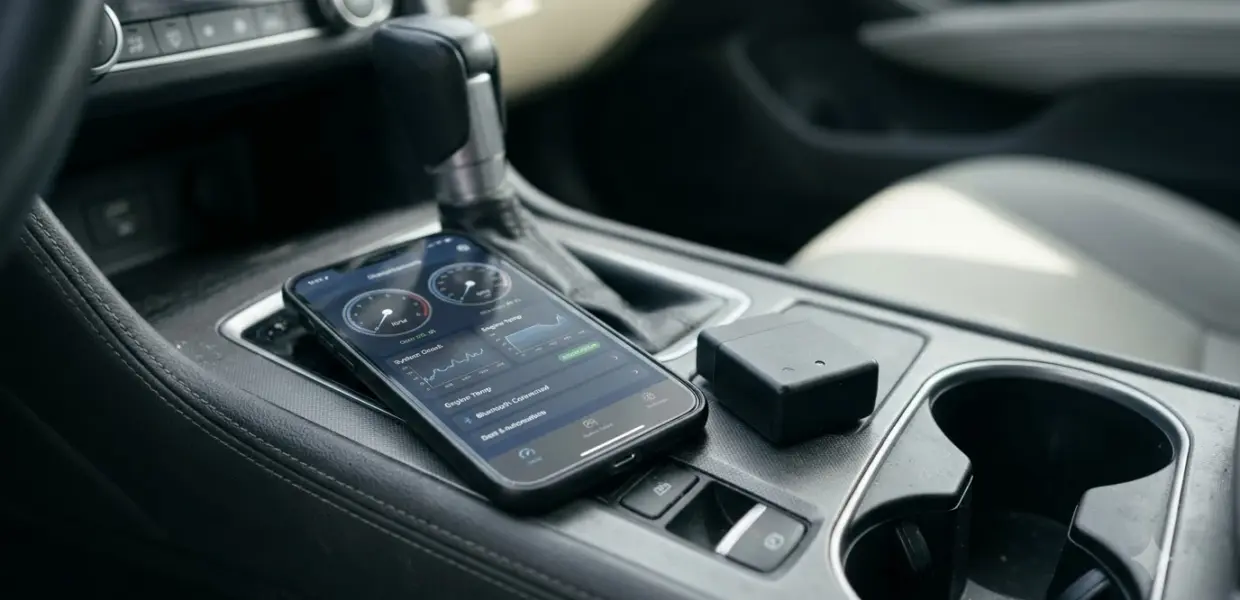

A Ford Focus check engine light means the car has stored a fault, and how the light behaves shows how urgent it is. A steady light usually points to a minor, repairable problem. A flashing light means act now. As of November 6, 2026, the fastest first step is reading the stored code.
Start with the cheap causes, such as a loose gas cap and visible leaks, before anyone replaces a catalytic converter. Stop driving as soon as it is safe if the light flashes.
Steady or Flashing: What a Ford Focus Check Engine Light Means
A steady Ford Focus check engine light usually means a minor, repairable fault that should be serviced soon. A flashing light means a severe fault that calls for immediate attention.
According to Wikipedia’s check engine light overview, a steady light signals a minor, repairable fault. A flashing light signals a severe fault that makes the vehicle unsafe to drive, which applies to a Ford Focus check engine light as it does to other cars. The table below sums up the difference.
| Light | What it signals | What to do |
|---|---|---|
| Steady | A minor, repairable fault, such as a loose gas cap | Service as soon as possible. A short drive to a shop may be acceptable with no symptoms. |
| Flashing | A severe fault, often an engine misfire | Stop driving as soon as it is safe and have the car checked right away. |
Identifix says that when a Ford Focus check engine light flashes, it calls for immediate action if the engine misfires, power drops sharply, or the exhaust overheats. A steady light with none of those symptoms may allow a short drive to a shop.
Reading the Codes Behind a Ford Focus Check Engine Light
An OBD-II scanner reads the stored code that turned on the Ford Focus check engine light. That code is a starting point for diagnosis, not a final verdict on which part failed.
Diagnosis starts by reading every stored code, not only the first one. The sources behind this guide are general code references, not Ford Focus service data, so confirm anything model specific with a Ford dealer or the owner’s manual. For another Ford model, see the Ford Fusion check engine light guide.
- Connect an OBD-II scanner to the diagnostic port and read all stored codes.
- Note whether the light is steady or flashing, and when the codes were set.
- Compare each code with the causes for a Ford Focus check engine light in this guide, and check the cheapest causes first.
Clearing a code with a scan tool turns a Ford Focus check engine light off faster, but it repairs nothing. Identifix notes that after a code is cleared the monitors must still run and pass before the vehicle is inspection-ready.
Check the Gas Cap and EVAP Leaks Before Replacing Parts
A loose gas cap is the single most common cause of a P0455 code, and it is the first thing to check. The guide on a check engine light from a loose gas cap covers that case. A Ford Focus check engine light caused by an EVAP code means the fuel vapor system has a leak somewhere.
In Identifix’s P0455 leak guide, P0455 is described as a gross leak, while P0456 is a smaller leak. Identifix lists the causes in this order, and each one is worth checking before a part is replaced.
- Tighten the gas cap and check its gasket for cracks, flat spots and hardening.
- Check the EVAP hoses for cracks or loose connections.
- Test the purge valve, vent valve and charcoal canister, which can each fail.
- Look at the filler neck for corrosion, which Identifix says is common in salt belt regions.
If the leak is still there, a smoke test is the next step. Identifix says a smoke test finds the leak faster than parts swapping. Federal rules, Identifix says, allow the module to turn the Ford Focus check engine light off after three consecutive drive cycles in which the EVAP test passes.
Identifix’s FAQ estimates that a new gas cap typically costs under $40. Canister or filler neck repairs can run several hundred dollars installed, so a cap check is the cheapest test.
P0420: Catalyst Efficiency Below Threshold, and What It Costs
P0420, titled Catalyst System Efficiency Below Threshold (Bank 1), is set when the upstream and downstream oxygen sensor readings do not match the expected catalyst behavior.
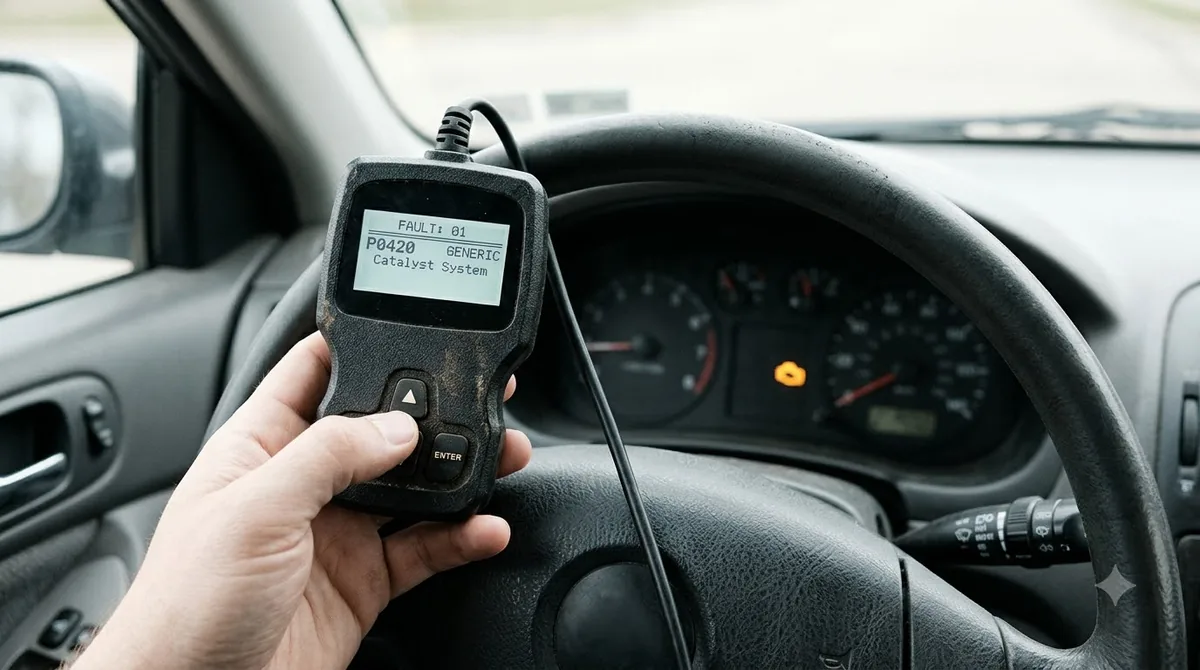
According to Identifix’s P0420 guide, the code does not prove the converter itself has failed. Check the code number on your scan tool, because the bank that reports the fault matters.
Identifix lists the usual causes of a P0420 code in order. They include a defective oxygen sensor, an exhaust leak, a cracked exhaust manifold, a fuel injector leak, a misfire and outdated PCM software.
The guide advises checking for leaks and testing the oxygen sensors before condemning the converter. A separate P0420 catalytic converter code guide covers the same code on other vehicles. An exhaust leak can add outside air near the sensors and skew their readings.
As of November 6, 2026, Identifix quotes RepairPal’s U.S. averages of $454 to $550 for an oxygen sensor replacement and $2,301 to $2,473 for a catalytic converter replacement. The source gives no year for these figures, and they are general averages, not prices for a Focus.
P0171: Running Lean and How to Narrow It Down
P0171 on a Ford Focus check engine light means Bank 1 is running lean, with more air than the fuel system can correct. The computer has exceeded its fuel correction range, so it cannot restore the mixture on its own. The P0171 lean code guide explains the code in general terms.
The code library OBDAdvisor ranks the causes as a dirty mass airflow sensor first, then vacuum leaks, then fuel starvation.
- Read the short-term and long-term fuel trims at idle with a scanner that shows live data.
- Repeat the reading at 2500 RPM and compare the two results.
- Trims that are high at idle and drop at 2500 RPM point to a vacuum leak.
- Trims that stay high or get worse at 2500 RPM point to the MAF sensor or the fuel supply.
If fuel supply is the suspect, check fuel pressure. OBDAdvisor gives a typical range of 30 to 65 PSI and tells you to check your service manual for the exact spec, so use the figure for your own engine. Low pressure points to a weak pump, a clogged filter or a leaking regulator.
Foxwell describes P0171 as moderately serious. You can drive a short distance, but the car should be repaired as soon as possible, because long driving can overheat and damage the catalytic converter.
When the Light Flashes: Misfire Codes Come First
A flashing Ford Focus check engine light usually means the engine is misfiring, and misfire codes should be fixed before lean or catalyst codes are chased.
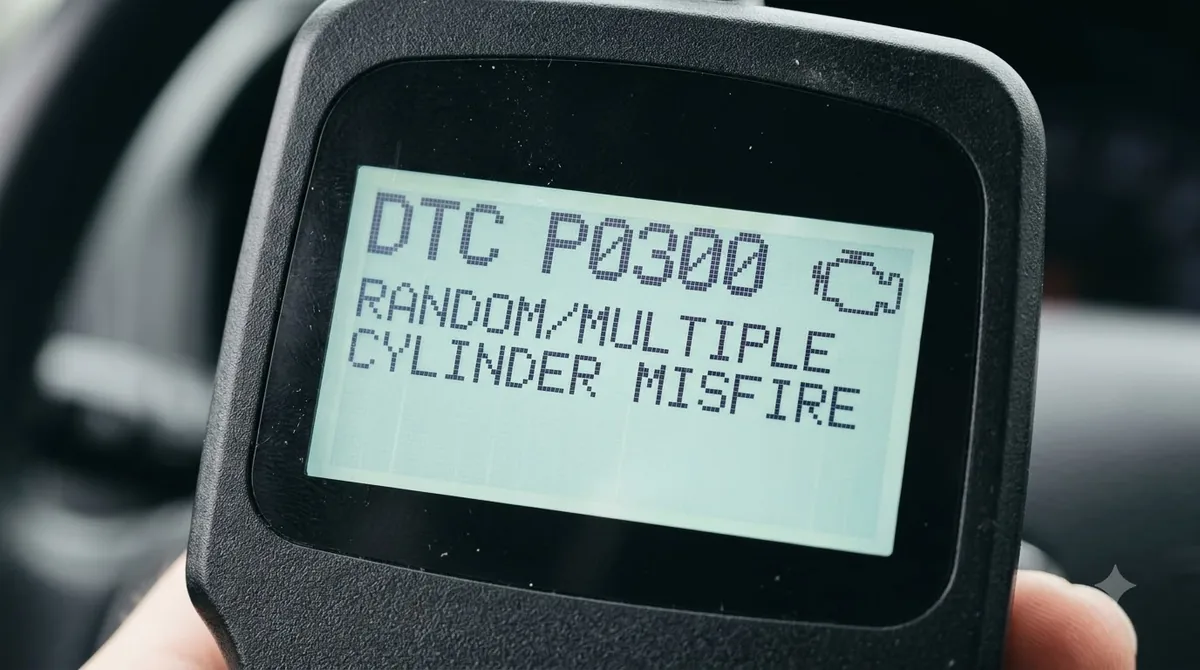
The photo above shows P0300 on the scanner display, which names a random or multiple cylinder misfire. The P0300 random misfire code guide explains that code in general terms. OBDAdvisor advises fixing the P0300 to P0312 misfire codes first, because a misfire can cause a false lean reading.
Foxwell lists misfire or stalling among the symptoms of a P0171 code. A flashing light with any of these symptoms should prompt a stop, not a longer drive.
Five Checks to Run Before a Repair Shop Visit
Five checks, in this order, rule out the cheapest causes before any part is bought for a Ford Focus check engine light, starting with the light status and the stored code.
- Decide whether the light is steady or flashing. If it flashes, stop driving as soon as it is safe.
- Read the stored codes with an OBD-II scanner and write them down.
- Tighten the gas cap, then check the filler neck seal and the EVAP hoses.
- Look for exhaust leaks and cracked vacuum hoses that could let in unmetered air.
- Bring the codes and symptoms to a shop, and ask for a smoke test and sensor readings before any converter replacement.
Frequently Asked Questions
Can I drive with the check engine light on?
A steady Ford Focus check engine light with no drivability symptoms may allow a short drive to a shop, according to Identifix. Get it checked soon, because long driving with a lean code such as P0171 can overheat the catalytic converter. If the light flashes, stop driving as soon as it is safe. Another Ford SUV, the Explorer, has its own Ford Explorer check engine light guide.
Is a flashing check engine light an emergency?
Yes, a flashing Ford Focus check engine light is treated as an emergency. Wikipedia describes it as a severe fault that makes the vehicle unsafe to drive, and Identifix says it calls for immediate action. Stop driving as soon as it is safe and have the car checked before the next trip.
Will a loose gas cap turn on the check engine light?
Yes, a loose gas cap can turn on the Ford Focus check engine light. Identifix calls a loose cap after refueling the most common cause of a P0455 code and the first thing to check. Tighten the cap, and the module may turn the light off after three consecutive passing EVAP drive cycles.
Does P0420 always mean the catalytic converter is bad?
No. Identifix says P0420 does not prove the converter has failed. Defective oxygen sensors, exhaust leaks and misfires can all set the code, so the converter should be one of the last parts checked, not the first.
How much does it cost to fix a P0420 or P0171 code?
As of November 6, 2026, Identifix quotes RepairPal averages of $454 to $550 for an oxygen sensor and $2,301 to $2,473 for a catalytic converter. The source gives no year, and these are general figures, not Focus-specific prices. Get a written estimate before you approve any work.
Does clearing the code fix the problem?
No. Clearing the code with a scan tool turns the Ford Focus check engine light off faster, but it does not repair the fault. The emissions monitors must still pass, and the code can return if the cause remains. Fix the cause first, then clear the code and confirm the fuel trims.
Check the gas cap and look for leaks before you buy any part. If your Ford Focus check engine light is steady and the car drives normally, you have time to test. If it flashes, stop driving and get the car checked before the next trip.