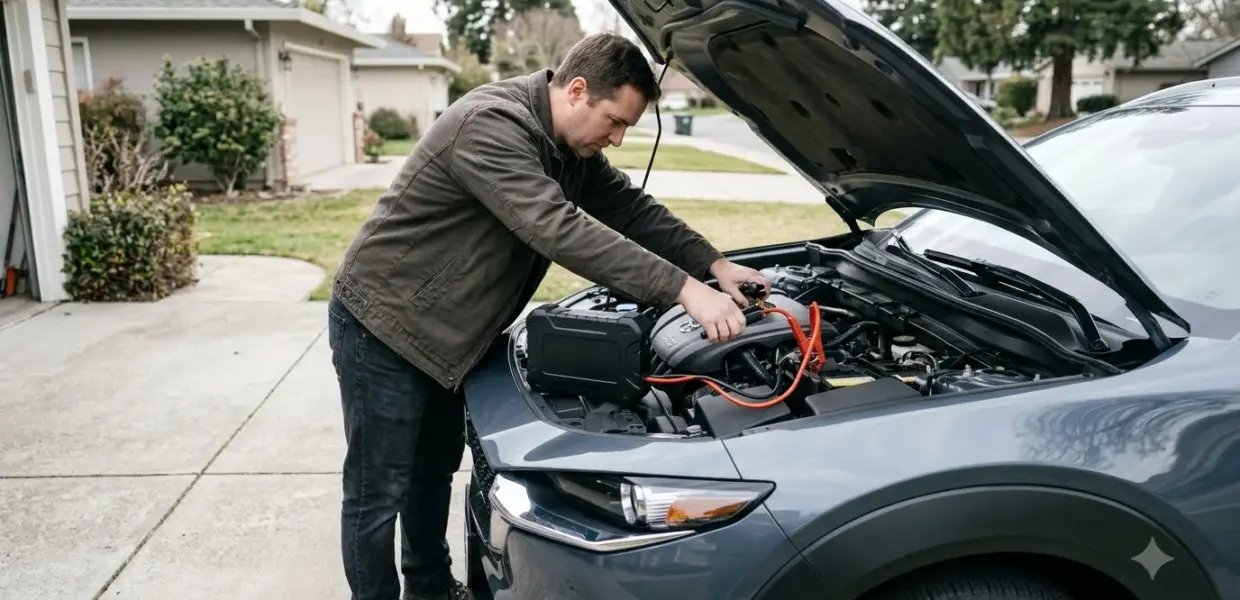

Learning how to use NOCO GB20 comes down to four steps: charge it fully, connect the clamps in the right order, wait for the boost light, then start the engine. The unit is built for 12-volt lead-acid batteries only.
Check your battery type before you connect anything, and read the safety warnings first. The guide covers every step, but your vehicle owner’s manual sets the jump point for your car.
Jump starting carries risks of fire, explosion and electric shock. Follow the GB20 user guide and your vehicle owner’s manual, and get professional help if you are unsure about the battery or the connection.
Check Your Battery Type Before You Connect
The GB20 is for 12-volt lead-acid batteries only, and the guide says it is not suitable for any other battery type. Before you learn how to use NOCO GB20 on a car, confirm the voltage and chemistry in your battery owner’s manual.
- A 12-volt lead-acid battery, which is the only type the guide supports.
- A battery that is not frozen or damaged, since the guide says not to jump start either.
- Terminals you can identify: positive marked POS, P or +, and negative marked NEG, N or -.
The unit detects a battery down to 2 volts. Below that, the Boost LED stays off unless you use the manual override, which disables spark-proof and reverse-polarity protection. The guide says to use that mode only with extreme care, and to seek professional help if you are unsure.
Charge the GB20 Before First Use
The GB20 ships partly charged, so charge it fully with the included USB cable before the first jump start. Connect the cable to the USB IN port, rated at 2.1 amps, and use a USB car charger, laptop or AC adapter.
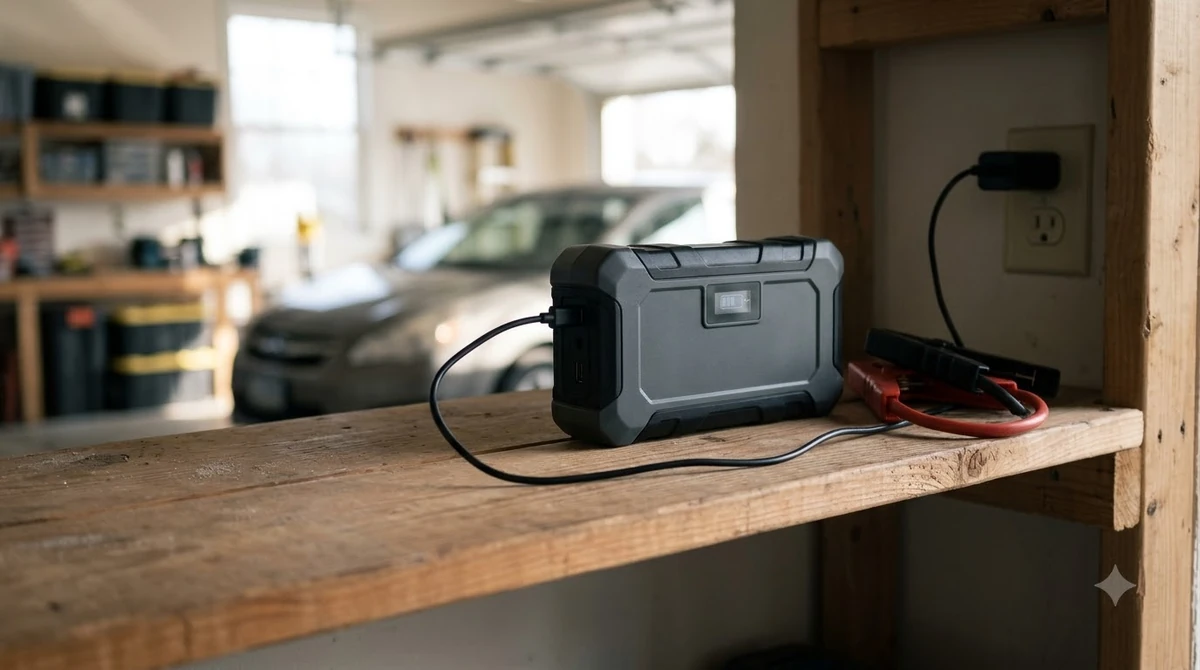
When you learn how to use NOCO GB20, plan around recharge time first. The guide says it depends on the charger rating and the discharge level. Use this table as the guide’s reference point for a typical recharge.
| Charger rating | Recharge time (per the GB20 guide) |
|---|---|
| 0.5 A | 12 hours |
| 1 A | 6 hours |
| 2 A | 3 hours |
Knowing how to use NOCO GB20 safely includes reading its indicators. The four charge LEDs show the level, and the green 100% LED stays solid when the battery is full. The guide also says not to charge and discharge the unit at the same time, and to avoid charging it for more than a week at a time.
How to Use NOCO GB20: Connect the Clamps in Order
Connect the clamps to the 12V OUT port first, then attach the red clamp to positive and the black clamp to negative or chassis. The guide gives this standard order for a negative-ground vehicle, which it calls the most common setup.
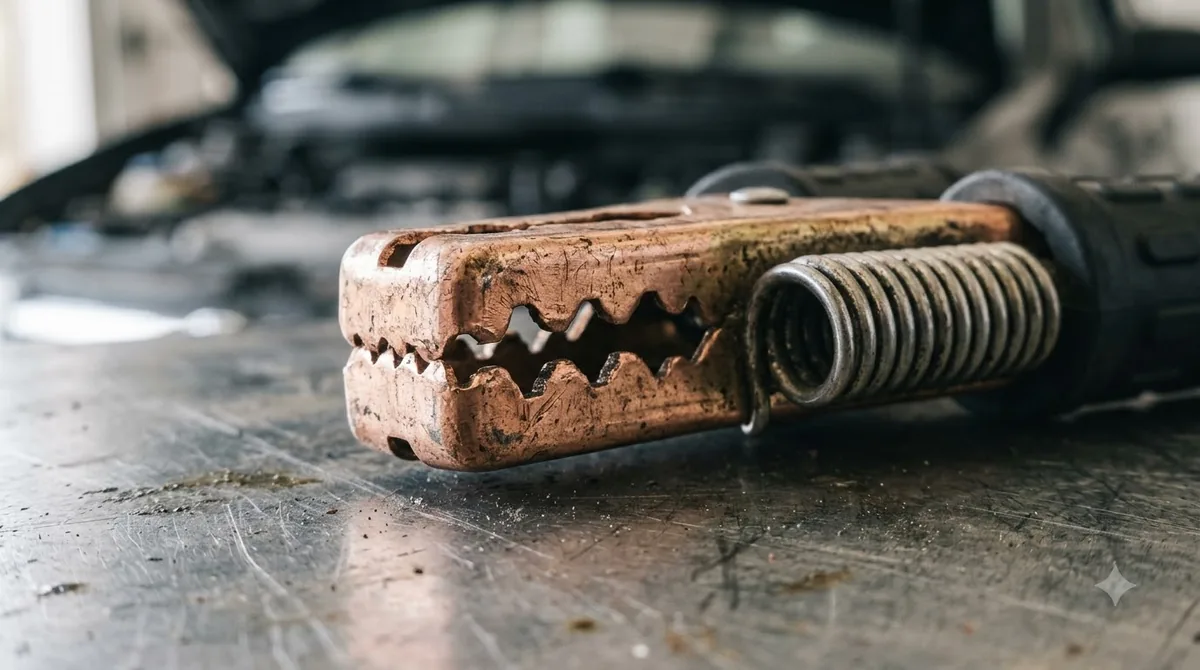
- Plug the clamps into the GB20’s 12V OUT port.
- Attach the red positive clamp to the positive (POS, P or +) battery terminal.
- Attach the black negative clamp to the negative (NEG, N or -) terminal or vehicle chassis.
Clamp placement is part of how to use NOCO GB20 safely. Keep the clamps away from the carburetor, fuel lines and thin sheet metal parts, and position the leads away from fan blades, belts and pulleys. The guide says that for a positive-ground vehicle, which it calls very uncommon, you reverse the order.
How to Use NOCO GB20 to Start the Engine
Once the clamps are connected, press the power button and wait for the white Boost LED before you try to start the vehicle. This is the core of how to use NOCO GB20 on a dead battery. The guide says that is the sign the unit is ready to jump start your car.
- Turn off all vehicle loads, such as headlights, radio and air conditioning.
- Press the power button. All LEDs flash, then the white Boost LED lights when the clamps are connected correctly.
- If the red Error LED lights, the clamps are reversed. Reverse the connections to clear the error.
- Try starting the vehicle. Most start at once, but some need the unit connected for up to 30 seconds.
If the vehicle does not start, wait 20 to 30 seconds and try again. Retrying is part of how to use NOCO GB20, but the guide limits how often. The guide says not to make more than five consecutive jump starts within 15 minutes, and to let the unit rest for 15 minutes before the next attempt.
After the engine starts, disconnect the clamps in reverse order, removing the negative clamp first, then remove the GB20. Do not leave the unit unattended while it is in use. Finishing that step is the last part of how to use NOCO GB20. Compare this routine with the general jump starter safety steps.
Safety Limits and Warning Signs
Knowing when to stop is part of how to use NOCO GB20 safely. Stop using the GB20 if the battery is excessively hot, emits an odor, looks deformed or cut, or shows any other abnormal sign. The guide warns that the unit can cause electric shock, explosion, fire and burns if misused.
- Never jump start a frozen or damaged battery.
- Work in a well-ventilated area, with no sparks, flames or smoking nearby.
- Wear eye protection, since batteries can explode and release battery acid.
- Do not operate the unit if it becomes wet, and do not use damaged cables or a damaged power cord.
Product warnings are model-specific. The Consumer Product Safety Commission warned owners of Hererod PW40 and EW40 jump starters and power banks to stop using them, because their lithium-ion batteries can explode and ignite. Check your model against CPSC’s 2026 warning page and never assume a warning does not apply to you.
Keeping the GB20 Ready for Use
Storage affects how to use NOCO GB20 later. Store the GB20 on a flat, secure surface in a dry location, within the guide’s storage range of -20 to 50 degrees Celsius. An unused unit discharges over time, so recharge it before you need to use it.
- Recharge before use if the unit has sat unused for a long time.
- Power off the unit before any cleaning or maintenance.
- Wipe it with a soft, lint-free microfiber cloth, and dry it at once if it touches liquid.
Use the included USB charge cable and an approved power adapter. The guide says that generic or third-party adapters may shorten the life of the product and can cause malfunctions.
Who Should Use the GB20 and Who Should Not
Deciding whether to learn how to use NOCO GB20 starts with the battery. The GB20 suits 12-volt lead-acid car batteries that are intact and not frozen. It is a poor fit for lithium or other battery chemistries, and the guide says to contact the battery manufacturer if you are unsure of the chemistry.
People with a pacemaker or other medical device should consult a physician before they learn how to use NOCO GB20. The guide says the product contains magnetic components that may interfere with those devices. Keep the unit away from children, since it is not a toy and its accessories are a choking hazard. Larger engines call for a bigger pack, and the NOCO GB150 jump starter steps cover a higher-capacity unit.
Related Guides
Frequently Asked Questions
Can I use the NOCO GB20 on a lithium battery?
No. The guide says the product is compatible only with 12-volt lead-acid batteries, and jump starting other chemistries may cause injury, death or property damage. Check your battery owner’s manual first.
Why does the red Error LED light up?
If you follow how to use NOCO GB20 and the red light shows, the guide says the clamps are connected in reverse. Reverse the connections to clear the error, and the white Boost LED should light when the unit is ready.
How long should I wait between attempts?
Knowing how to use NOCO GB20 well means waiting 20 to 30 seconds after a failed attempt. Do not make more than five consecutive attempts within 15 minutes, and let the unit rest for 15 minutes before trying again.
How long does it take to charge the GB20?
Knowing how to use NOCO GB20 starts with a full charge. The guide lists about 3 hours at 2 A, 6 hours at 1 A and 12 hours at 0.5 A. The USB IN port is rated at 2.1 amps, and the time varies with the discharge level.
Can the GB20 jump a battery below 2 volts?
Only with the manual override, which disables spark-proof and reverse-polarity protection. The guide says to use that mode with extreme care and to seek professional help if you are unsure.
Is the GB20 safe with a pacemaker?
Consult your physician before use. The guide says the product contains magnetic components that may interfere with pacemakers and other medical devices.
Learning how to use NOCO GB20 is simple when you charge it fully, connect the clamps in order, and stop if anything looks damaged or hot. If you are unsure about the battery or the connection, get professional help before you try again.