
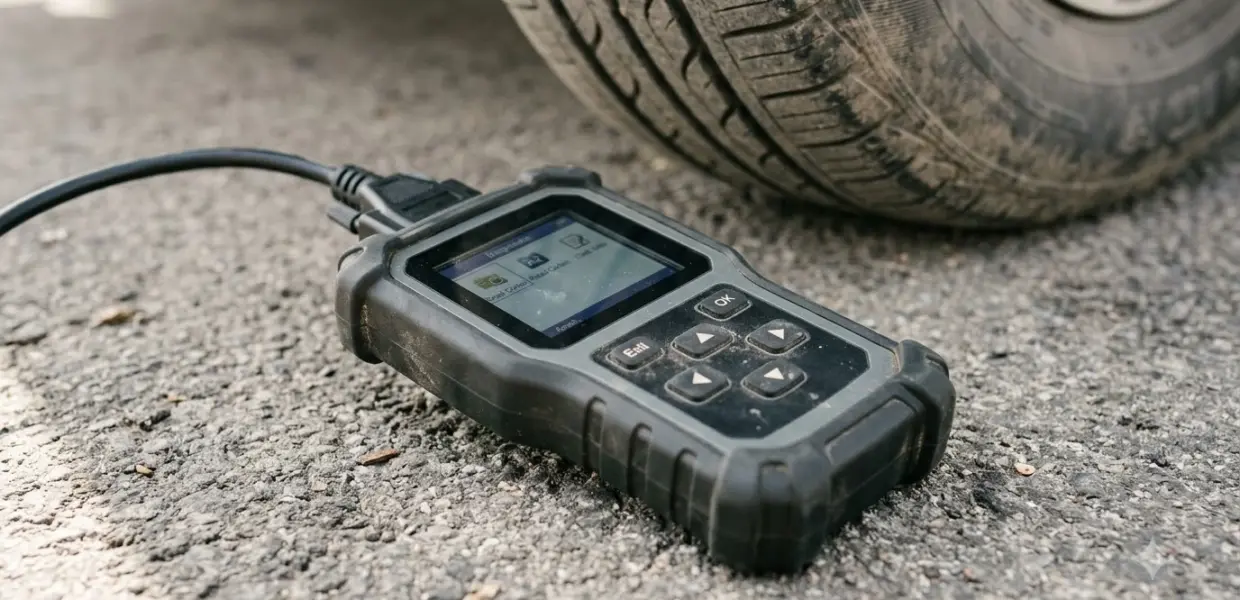

P0441 is an OBD-II code that means your vehicle’s evaporative emission control system has detected incorrect purge flow. The EVAP system keeps fuel vapor from escaping the tank, so the code points to a fault in that system rather than to one fixed part.
The cause can be a loose fuel cap, a purge valve, a leak in a hose, or damaged wiring. Check the simple items first, so you do not replace a part that was never faulty.
What P0441 means
P0441 is the code for an evaporative emission control system with incorrect purge flow, as Mazda and Volkswagen bulletins describe it. A leak, rather than a flow problem, sets a different code, as in this P0456 evaporative leak guide.

The EVAP system stops fuel vapor from escaping into the air. It stores that vapor in a charcoal canister, then lets it flow into the engine through a purge valve. The engine computer expects a certain flow, and when the measured flow does not match, it stores the code.
A specialist guide describes the purge valve as normally closed. It holds vacuum when unpowered and opens fully when energized, so a valve that does not behave this way can trigger the code.
According to the EPA’s OBD questions and answers, federal OBD rules set the EVAP leak detection threshold at a 0.040 inch orifice. That small size means cracks, gaps, and holes anywhere in the system can be detected.
Common causes, from cap to purge valve
Specialist guides list causes that run from a loose filler cap to a faulty purge valve, a vacuum leak, or damaged wiring. The list below covers the main groups.
- Fuel filler cap: a cap that is not closed properly after refueling can leak vapor.
- Purge valve: specialist guides name a bad valve first, and Acura’s bulletin 23-035 found a worn valve that sticks intermittently.
- Purge line and vacuum hoses: a clogged, disconnected, or cracked line can block flow or cause a vacuum leak.
- Charcoal canister, vent valve, and vapor pressure sensor: specialist guides list damage or faults in these parts as causes too.
- Wiring and connectors: an open or short circuit can set the code.
- Harness interference: Honda bulletin 21-081, covering 2017 to 2021 CR-V models, says external radio waves can make sensor output fluctuate in the harness, which sets a DTC.
The fuel cap point comes from Mazda’s service bulletin 01-002/18, which covers P0441 together with P0442, P0455, and P0456 on several Mazda models.
Not every P0441 case is a bad part. Volkswagen’s 2012 bulletin says a production tolerance in the DMTL pump can cause a false flow reading, and updated pumps came from September 2012 production.
Diagnostic steps to run before replacing parts
Run the simple checks first, and do not replace the purge valve until the leak checks are complete.
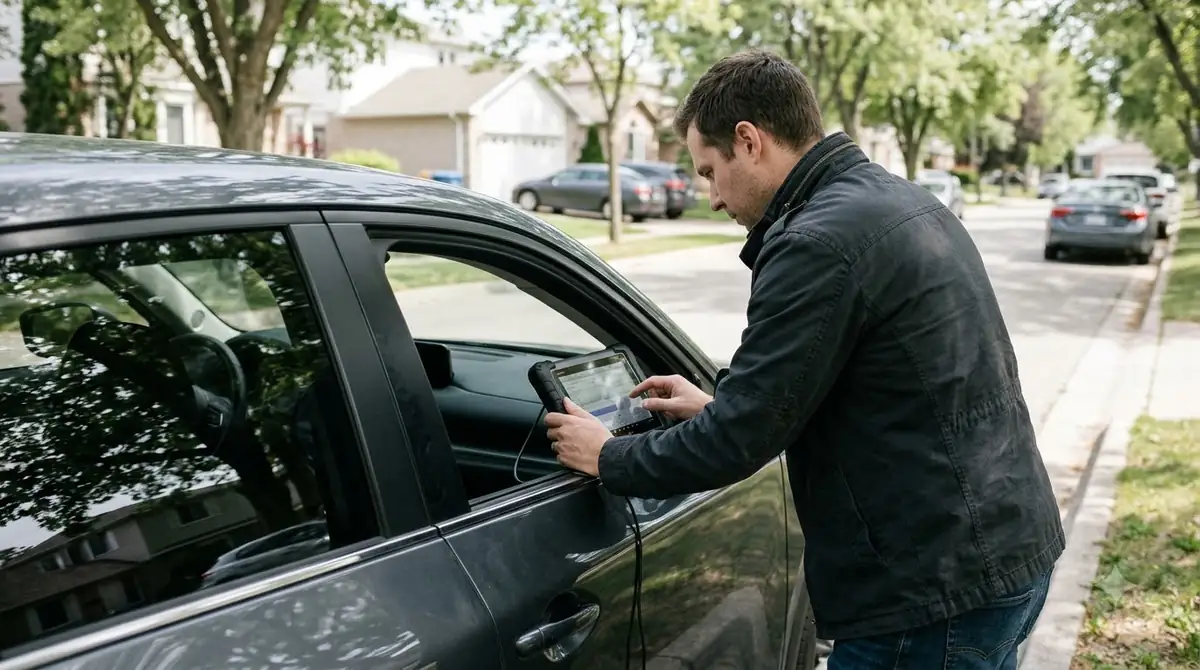
- Scan for other stored codes, including P0442 and other fuel-system codes. Mazda’s bulletin says to check these before following its leak procedure.
- Clear the stored code, then drive the car to see whether it comes back.
- Inspect the EVAP hoses for obvious cracks, both between the tank and the purge valve and between the valve and the intake manifold.
- Test the purge valve with a scan tool or a hand-held vacuum pump.
- Smoke test the EVAP system for leaks if the simpler checks do not find the fault.
Volkswagen’s 2017 bulletin says to smoke test the EVAP system for leaks before its procedure, and to reevaluate after repairs. It also says not to diagnose or replace the canister purge valve N80 before that procedure.
Mazda’s bulletin for P0441 begins by checking for other stored codes, then runs a key-on, engine-off EVAP test with an ultrasonic leak detector at the filler cap. Its note reads: when diagnosing an evaporative emissions leak from the fuel filler cap, DO NOT TOUCH the fuel filler cap.
If the ultrasonic test finds a leak at the cap, the bulletin moves to the cap and filler pipe. A loose cap gets tightened, and rust or debris on the threads is removed, with replacement if the threads are damaged or rusted. If no cap leak is found, the bulletin skips straight to checking for leaks elsewhere in the system.
The purge valve is checked next with a hand vacuum pump. The bulletin applies 18 inHg (60 kPa) of vacuum to the valve and expects it to stay between 18 and 9 inHg after ten seconds, then repeats the check at 3 inHg, which should stay between 3 and 2 inHg. If both checks pass, the bulletin moves on, and if neither is met, it says to replace the purge solenoid valve.
One repair guide says a smoke test requires special equipment and skills. It also gives a fuel tank level of 15 to 85 percent for an accurate result, so ask the shop about the fuel level before the test.
Volkswagen’s technical background says the guided function test and a vacuum check on valve N80 are essential to avoid unnecessary replacements. Replacing the purge valve first is the mistake that bulletin warns against.
Is P0441 safe to drive with?
One repair guide says P0441 is not usually anything serious, and specialist sources say it often causes no driveability symptoms. For the general meaning of a lit dash light, see what the service engine soon light means.
The practical costs of P0441 are a lit check engine light, a possible failed emissions test, and a faint fuel smell. The same guide says you do not need to fix it right away, though the code still deserves a diagnosis.
Specialist guidance says the engine may surge or run rough at idle in some vehicles. If a rough idle or another warning light appears with P0441, have the car checked sooner.
Severity labels differ between repair sites, and none of the reviewed sources gives a manufacturer position on driving with this code. Treat this section as a starting point, not a verdict on your car.
Which vehicles do the bulletins cover?
Each bulletin covers only the models, years, and engines it lists, so match your VIN before you follow any procedure.
| Make | Model years | Bulletin |
|---|---|---|
| Mazda | 2004 to 2010 Mazda3; 2003 to 2010 Mazda6; 2007 to 2010 CX-7; 2006 to 2010 Mazda5; 2006 to 2015 MX-5; 2007 to 2010 Mazdaspeed3; 2006 to 2007 Mazdaspeed6 | TSB 01-002/18, covering P0441 with P0442, P0455, and P0456 |
| Volkswagen | All except Routan, 2009 to 2017 gasoline engines | 2017 EVAP bulletin, smoke test first |
| Volkswagen | 2012 to 2013 Passat (2.5L), Beetle and Jetta (2.5L and 2.0T) | 2012 DMTL pump bulletin |
| Acura | 2018 to 2020 MDX; 2022 to 2024 MDX; 2018 RDX; 2018 to 2020 TLX (V6 only) | Service bulletin 23-035, version 2 |
| Honda | 2017 to 2021 CR-V EX, EX-L, and Touring | Service bulletin 21-081 |
The Mazda bulletin covers P0441 only for the models and VINs it lists. Its Mazda3 entry stops at 2010, so a 2011 Mazda3 falls outside it, and the VIN list should be checked before any of its steps are applied.
Acura’s service bulletin 23-035 names a different cause than Honda’s 21-081. It points to a purge control solenoid valve whose spring variation lets the valve wear unevenly and stick, and the repair is replacing that valve followed by an EVAP function test.
The 21-081 bulletin’s corrective action is a sub cord to the driver and passenger harness, or to the passenger side only, selected by VIN. That shows how a bulletin fix depends on the exact vehicle.
Frequently Asked Questions
Will P0441 clear on its own?
It can. According to the EPA’s OBD guidance, the malfunction light goes off after three consecutive trips in which the problem does not recur. If the light returns, have the system checked.
Can a loose gas cap cause P0441?
Yes. According to Mazda’s bulletin, a fuel filler cap that is not closed properly after refueling can leak EVAP vapor and store P0441. The same bulletin says not to touch the filler cap when diagnosing a cap leak.
Is it safe to drive with P0441?
One repair guide says P0441 is not usually anything serious, and specialist sources say it often causes no driveability symptoms. The code still deserves a diagnosis, and a rough idle or another warning light means the car should be checked sooner.
Is P0441 the same as P0442?
No. P0441 means incorrect purge flow, while P0442 means a small leak in the EVAP system. Mazda’s bulletin 01-002/18 covers both codes together with P0455 and P0456, but the checks differ by code.
Bulletins are model-specific, so confirm your make, model, year, and engine before acting on one. If none of them match your car, run the general checks above and have a technician test the EVAP system before you replace a part.
