
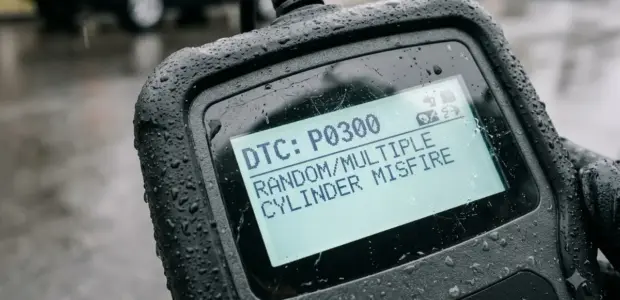

A P0300 code means your engine computer has detected random or multiple cylinder misfires, with no single cylinder named. A misfire is a combustion event where the fuel and air in a cylinder fail to burn properly.
The cause can be a worn spark plug or a vacuum leak, or a more serious fuel-delivery or mechanical problem. Check the causes and the diagnosis steps before you buy parts.
What the P0300 Code Means
This code means the engine computer saw misfires spread across several cylinders with no consistent pattern. That points to a system-wide cause rather than one failing cylinder.
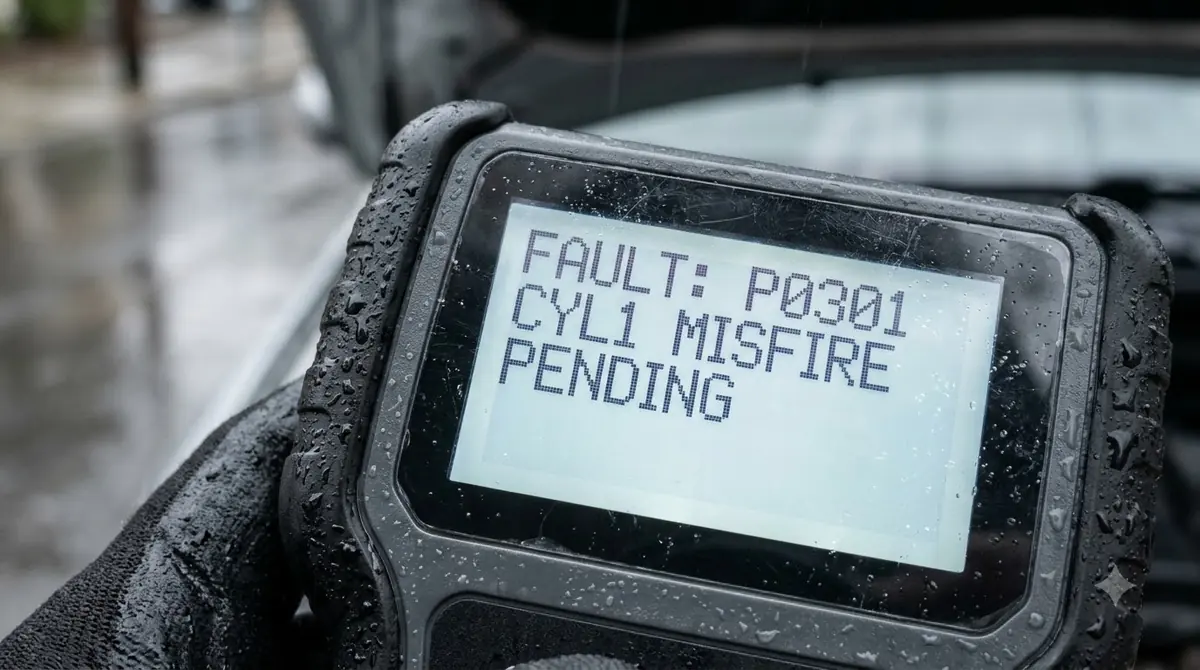
The computer detects misfires by watching crankshaft speed. When a cylinder misfires, the crankshaft slows for a moment, and the computer logs it. A single-cylinder code, such as P0301, names the failing cylinder, which makes the search shorter. The code gives you no starting cylinder, so the diagnosis takes more steps.
Common P0300 Causes
The most common causes of this code are worn spark plugs or ignition coils, followed by vacuum leaks and low fuel pressure. Ignition parts sit at the top of the list, so they are the first thing to check.
Because several cylinders are involved, one symptom can come from very different parts. A rough idle might trace back to a worn plug in one car and a vacuum leak in another, so the code alone does not tell you which part to replace.
According to OBD Advisor’s misfire code guide, the usual causes fall into a few groups, ranked from most to least common.

- Worn spark plugs or ignition coils, including coil boots with carbon tracking or oil on them
- Vacuum leaks from cracked PCV hoses, intake manifold gaskets, brake booster lines or a stuck-open EGR valve
- Low fuel pressure or a failing fuel pump, including a leaking check valve
- A stretched timing chain or damaged tone wheel, which upsets cam and crank timing
- A weak battery or failing alternator
- Faulty or clogged fuel injectors
- Mechanical wear, such as burned exhaust valves, worn rings or a blown head gasket
Symptoms and Whether It Is Safe to Drive
This code usually shows up as rough idle, hesitation and power loss, and an active misfire can damage the catalytic converter in minutes. Drivers often notice these signs first. A blinking warning lamp during a misfire is an urgent sign, and what a blinking dash light means explains why.
- Rough idle and vibration
- Hesitation or stumbling under load
- Hard starting, especially when the engine is cold
- Power loss during acceleration
- Higher fuel consumption
A flashing check engine light is a sign of an active misfire. OBD Advisor warns that active misfires can destroy the catalytic converter in minutes, and that repair costs far more than a spark plug job. Stop driving when the light flashes, and have the car checked before you go further.
Drivers who notice these signs should note when they happen, such as on cold starts, during hard acceleration or while idling at a stop light, because the pattern narrows the cause.
A steady light is less urgent, but the code still needs a diagnosis before a small misfire turns into a larger repair.
How to Diagnose a P0300 Code
Diagnosis means finding which cylinder or system is failing, using a scan tool with live data and misfire counters. Swapping parts at random wastes money and rarely finds the cause. Vacuum leaks that set a lean code can also cause rough running, as lean fuel trim code causes describes. When ignition parts check out, engine compression testing steps shows how to rule out mechanical wear. Timing checks are described in checking ignition timing with a light.
A basic code reader shows only the stored code. A scan tool with live data can show misfire counters and fuel trim values while you drive, which helps you diagnose a P0300 code more accurately.
Fuel trim readings help too. Long-term trims above +10 percent point to a lean condition, and +15 percent or higher strongly suggests a vacuum leak or a fuel delivery problem, according to OBD Advisor.
- Inspect the spark plugs and coil boots for wear, fouling, oil and carbon tracking. Swap a suspect coil to another cylinder to see whether the misfire moves with it.
- Look for vacuum leaks. Use smoke or carburetor cleaner around the intake while the engine idles to find them.
- Test fuel pressure. A typical spec is 40 to 60 PSI on port-injected engines, and a drop of more than 5 PSI under load points to a failing pump.
- Run a cold-start leak-down test. Pressure that drops more than 5 to 10 PSI over 15 to 20 minutes suggests a leak.
- Run a compression test. Cylinders should read within 10 percent of each other, and readings below 100 PSI point to a mechanical problem.
How Much a P0300 Fix Costs
Most P0300 repairs cost under $300 when they involve spark plugs or coils, while timing chain or catalytic converter work can reach $1,000 to $2,500 or more, as of November 3, 2026.
The P0300 cost to fix depends on the failed part. The figures below are DIY and shop ranges from OBD Advisor, so compare local quotes before you commit.
| Repair | DIY cost | Shop cost |
|---|---|---|
| Spark plugs (full set) | $20 to $60 | $100 to $250 |
| Ignition coils | $25 to $80 each | $75 to $200 each |
| Vacuum hose | $5 to $20 | $75 to $200 |
| Intake manifold gasket | $30 to $80 | $300 to $600 |
| Fuel pump | $100 to $250 | $400 to $800 |
| Timing chain and tensioner | $150 to $400 (parts) | $800 to $2,000 or more |
| Catalytic converter | $200 to $500 | $1,000 to $2,500 or more |
Overall, the source puts a DIY fix at $30 to $300 and a shop fix at $150 to $1,000 or more. Most cases resolve with spark plugs or coils for under $300.
Labor often matters as much as parts. Spark plugs and coils are usually quick jobs, while timing chain work takes far longer because more of the engine must be opened up. Ask for an itemized quote that lists parts and labor separately.
How to Fix P0300 Step by Step
To fix a P0300 code, check the cheapest causes first, such as spark plugs, coils and vacuum hoses. Then confirm the misfire is gone with a test drive and a fresh scan.
Clearing the code alone usually does not fix the problem. The code returns if the misfire continues, so the cause must be repaired first.
- Replace worn spark plugs and check the coil boots for carbon tracking or oil.
- Repair any vacuum leak, such as a cracked PCV hose, before you buy fuel or ignition parts.
- If fuel pressure is low, test the fuel pump and its check valve before replacing anything.
- Clear the code, then drive the car and watch whether the misfire returns.
- If the misfire remains, get a shop diagnosis for compression or timing issues, since the timing chain and catalytic converter are the costliest repairs.
Keep a record of each repair and the date. If the misfire returns after a part is replaced, that part was not the cause, and you can move to the next check on the list.
Frequently Asked Questions
Is P0300 the same as P0301?
No. This code means random or multiple cylinder misfires with no single cylinder named, while P0301 names cylinder 1 as the misfiring cylinder. A single-cylinder code narrows the search, so diagnosis is usually quicker. Without a named cylinder, the problem is system-wide, according to OBD Advisor.
Can a bad fuel pump cause a P0300 code?
Yes. Low fuel pressure or a failing fuel pump is one of the common causes listed for this code. A fuel pressure test shows whether the pump keeps up under load. A typical spec is 40 to 60 PSI on port-injected engines, and a drop of more than 5 PSI under load points to a failing pump.
Will the P0300 code go away on its own?
No. Clearing the code or waiting does not repair the misfire. If the code returns, the cause is still there. Ongoing misfires can damage the catalytic converter, so it is better to diagnose the problem than to wait for the code to disappear.
Can I drive with a P0300 code?
Avoid driving with an active misfire. A flashing check engine light means the misfire is happening now, and OBD Advisor warns that it can destroy the catalytic converter in minutes. If the light is steady, drive only as far as needed to reach a repair shop.
How much does a P0300 fix cost at a shop?
Shop prices for these repairs run from about $150 to $1,000 or more, depending on the failed part, according to OBD Advisor’s cost table as of November 3, 2026. Spark plugs cost $100 to $250 at a shop, and ignition coils cost $75 to $200 each. Timing chain and catalytic converter work costs the most.
Do not replace every part at once when a P0300 code appears. Start with the cheap checks, record which cylinder or fuel reading changes, and keep the flashing light in mind. If the light flashes or the engine runs rough, stop driving and get a proper diagnosis.
