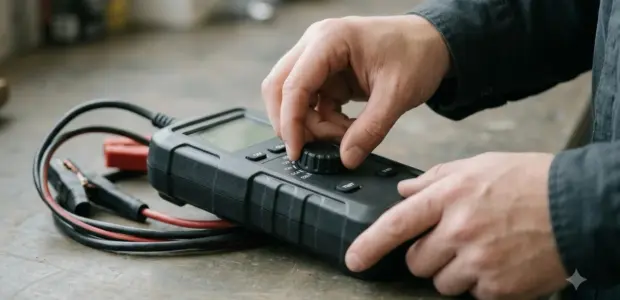

Learning how to use a battery tester takes four steps: set the rated CCA, connect the clamps, run the test with loads off, and read the LED result. Follow the manual for your model, because button sequences differ between brands.
A conductance tester and a load tester answer different questions, so choose by what you need to know. Check the CCA printed on the battery label before you start. This guide covers how to use a battery tester of either type.
Lead-acid batteries contain acid and can release hydrogen gas. Follow your tester manual and your vehicle manual, and test in a ventilated area.
What a Battery Tester Measures
A battery tester estimates whether a 12V battery can still deliver cranking power, and most models do this without fully discharging the battery. Two designs are common, and each answers a different question when you learn how to use a battery tester.
| Tester type | What it estimates | Load applied | CCA entry needed |
|---|---|---|---|
| Conductance tester | Available power and battery condition | Set by the tester | Yes, from the label |
| Load tester | Voltage held under a set load | Half of CCA for 10 to 15 seconds | Yes, to set the load |

A conductance tester, such as the Midtronics PBT-300, reports a rating and a condition result from the clamps. A load tester draws a set current and shows the voltage while the load runs, which tests the battery under stress.
What You Need Before You Start
Before you connect a tester, gather the battery’s CCA rating, clean the posts, and turn off the ignition and every accessory. These steps prevent most wrong readings, and they matter as much as the button presses when you learn how to use a battery tester.
- The CCA rating printed on the battery label
- A wire brush for the posts or side terminals
- Stud adapters for side-post batteries, if your tester needs them
- Gloves and eye protection
The Midtronics PBT-300 manual says dirty or worn stud adapters, and steel bolts, can produce false results. Tighten the adapters fully and use the test posts as the manual describes. Getting this right is part of how to use a battery tester on side-post batteries.
How to Use a Battery Tester With a Conductance Tester
To run a conductance test, select the CCA rating, connect red to positive and black to negative, press TEST, and read the LED result. The Midtronics PBT-300 instruction manual gives the connection order and the button sequence used below.
Selecting the rating (CCA)
The CCA rating is printed on the battery label. The PBT-300 scrolls from 100 to 1400 CCA and starts at 500, so the default is not the right value for every battery. Enter the number on your label.
- Turn off the ignition and every accessory, and clean the posts.
- Connect the red clamp to the positive terminal and the black clamp to the negative terminal. Rock each clamp back and forth to make a firm connection.
- Check the rating system shown on the display. If it is not CCA, follow the manual to change it.
- Use the arrow buttons to scroll to the battery’s CCA rating, then press TEST.
- Read the LED lights and the display. The display alternates between voltage and available power.
The tester’s LED chart links the lights to three outcomes: the battery is good, the battery needs a charge and a retest, or the battery should be replaced. Check the chart printed on your own model before you act on a color, since reading the lights correctly is the last step of how to use a battery tester.
The PBT-300 manual also covers in-vehicle starting and charging checks. Both need the battery to be good and fully charged, so the first step of how to use a battery tester is to check the battery itself. For the starting test, hold the down arrow to read cranking voltage with the engine cranking. For the charging test, rev the engine at 2000 rpm for 15 seconds, then hold the up arrow to read the highest average charging voltage. A reading between 13.3 V and 15.5 V means the charging system is OK.
How to Run a Load Test on a Car Battery
A car battery load test applies a load of about half its CCA for 10 to 15 seconds, then checks the voltage. Under 9.6 volts during the load suggests a weak battery, according to a third-party guide. If it needs a charge, see battery charger setup and safety.
- Measure the resting voltage with the engine off. A fully charged 12V battery reads about 12.6 volts, according to batteryskills.com.
- Connect the load tester positive to positive and negative to negative, with firm clamps.
- Apply a load equal to half the battery’s CCA for 10 to 15 seconds.
- Watch the voltage. Staying at about 9.6 volts or higher means the battery passes this test.
The 9.6 volt pass line comes from a third-party guide, not a manufacturer. The PBT-300 manual uses 9.6 volts for a different check: its starting system test passes when cranking voltage stays above that level. Use your own tester manual for pass criteria, and check where any pass line comes from before you trust it when you learn how to use a battery tester.

Why Your Reading Is Wrong and How to Fix It
The most common false readings come from surface charge, a running engine, or a loose connection. The Midtronics manual says to turn on the headlights for 30 seconds and let the battery rest for 1 minute before retesting. If the battery tests fine, alternator charging checks is the next step.
- Surface charge: a recently run or charged battery can read high. Turn on the headlights for 30 seconds, then rest the battery for 1 minute.
- Loads on: lights, the radio, or the ignition can skew the result, so turn them off.
- Bad connection: a “conn” message means the clamps need reconnecting. Disconnect, reconnect and rock the clamps.
- Dirty terminals: clean the posts with a wire brush before you clamp on.
- Charger noise: a nearby charger can reset the tester. Move away from it and retest.
If the top red LED lights during an in-vehicle test, the manual says there may be a poor connection between the battery cables and the vehicle. Disconnect the cables and retest at the battery posts before replacing the battery.
If the display flashes or shows one flashing letter, the battery is below 8 volts and too low to test. The manual says to fully charge the battery and retest. A “bAd CELL” message means one or more cells are bad. Working through this list before you accept a result is part of how to use a battery tester correctly.
Safety Before You Test
An OSHA interpretation letter from 1997 says lead-acid batteries can leak acid and emit hydrogen gas, which may cause a fire or explosion when ignited. Treat every test as a chance for a spark, and keep that in mind whenever you learn how to use a battery tester. The OSHA letter also notes that leaking batteries may expose people to the acid they contain. A meter gives a quick second opinion, as digital multimeter voltage checks describes.
- Test in a ventilated area, away from open flames and sparks.
- Wear gloves and eye protection.
- Keep metal tools from touching both posts at the same time.
- Do not test a battery that is cracked or leaking.
Frequently Asked Questions
How to use a battery tester with the engine running?
The Midtronics PBT-300 manual says to turn the ignition and accessory loads off for an in-vehicle test, because testing with the ignition on or loads on may give inaccurate readings. Starting and charging checks have separate steps in the manual, so follow those steps exactly.
What does a “bAd CELL” message mean?
A “bAd CELL” message means one or more battery cells are bad. The Midtronics PBT-300 manual says to replace the battery in that case. Check the display messages in your own tester manual, since other models may use different wording.
What if the display flashes or shows one flashing letter?
On the PBT-300, a flashing display or one flashing letter means the battery is below 8 volts and too low to test. The manual says to fully charge the battery and retest. Let the battery settle after charging, then repeat how to use a battery tester from the start.
How do I find the right CCA number?
Use the CCA rating printed on the battery label, not the default value on the tester. The PBT-300 offers CCA values from 100 to 1400 and starts at 500. Other rating systems, such as SAE or EN, appear in the same menu, so pick the one that matches your label. Choosing the right rating is the first setting in how to use a battery tester.
What is a good voltage for a fully charged car battery?
A fully charged 12V car battery reads about 12.6 volts with the engine off and no load, according to batteryskills.com, a third-party guide. A reading well below that suggests the battery needs charging before you test it. Check the reading with a multimeter first, then learn how to use a battery tester if the result still looks off.
Do I need a load tester if I have a battery tester?
Not always. Learning how to use a battery tester gives a quick estimate of battery condition, while a load test applies a real load for about 10 to 15 seconds. Use a load test when the tester result is unclear or the battery seems weak, and follow your tester manual for its exact steps. A load test is the second part of how to use a battery tester.
If a battery fails after a full charge and a retest at the posts, replace it. Retesting first is the simplest way to use a battery tester without buying a new battery by mistake, since a loose or dirty connection can cause the reading.