
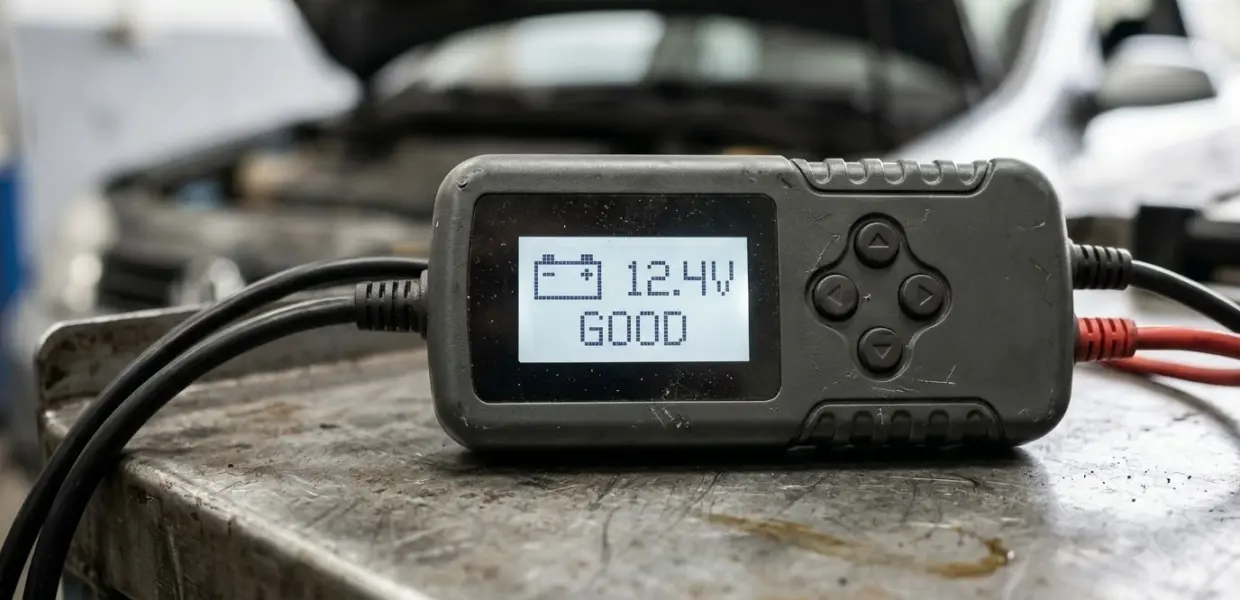

Knowing how to test a battery with a multimeter takes about five minutes. Set the meter to DC voltage, touch the probes to the terminals, and read the resting voltage. A multimeter is a handheld meter that measures voltage, current and resistance.
Knowing how to test a battery with a multimeter gives you a number that shows the charge level. Compare it with your battery type’s band, and retest with the engine running if it looks low.
This guide on how to test a battery with a multimeter covers basic voltage checks on common batteries. It does not replace the vehicle maker’s service manual or a professional inspection, especially for hybrid or high-voltage systems.
What You Need Before You Test
You need a digital multimeter with a DC voltage setting, safety glasses, gloves and clear access to the battery terminals. Keysight’s multimeter guide tells you to turn the dial to DC voltage mode for any battery voltage check. Before you start, pick a meter with a range above the battery’s rated voltage, so the reading does not overload the dial.
- A digital multimeter with a DC voltage mode
- Safety glasses and gloves
- A well-ventilated work area
- A fire extinguisher nearby when you test a large or high-capacity battery
How to Test a Battery with a Multimeter in Five Steps
Turn the headlights on for about two minutes, then off, set the meter to DC voltage, place the probes on the terminals, read the resting voltage, then start the engine and read again. Follow this order for how to test a battery with a multimeter on a car. The headlight step clears the surface charge left by recent driving or charging, which can push the reading above the battery’s real state.
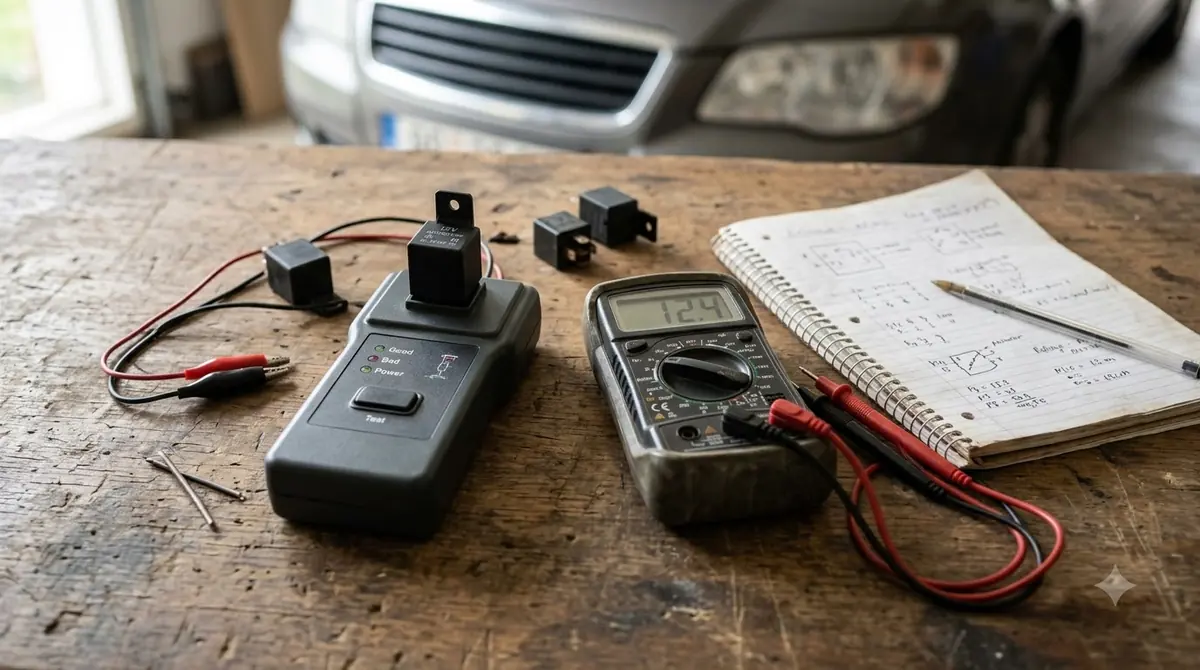
- Turn the headlights on for about two minutes, then turn them off.
- Set the multimeter to DC voltage and choose a range from 0 to 20 volts.
- Touch the red probe to the positive terminal, usually marked with a plus sign, and the black probe to the negative terminal, usually marked with a minus sign.
- Read the resting voltage. Interstate Batteries expects about 12.5 volts with the engine off, according to its car battery test guide.
- Start the engine and read again. The voltage should be higher than 13 volts.
If the engine-running reading stays below 13 volts, the alternator or the battery could be the cause, so have a professional check the charging system before you rely on the car. The steps for how to test an alternator with a multimeter show the next checks. Write down each reading with the time and whether the engine was running, so you can compare results later. When you repeat the test, use the same probe placement each time.
Reading Your Results: What the Numbers Mean
A car battery with the engine off should read about 12.5 volts, and Keysight lists 12.4 to 12.7 volts as the healthy band for a car battery. Use the table below to compare your reading with each battery type.
| Battery | Healthy | Weak | Dead |
|---|---|---|---|
| Car battery (12 V) | 12.4 V to 12.7 V | 12.0 V to 12.3 V | Below 12.0 V |
| AA or AAA cell | 1.5 V to 1.6 V | 1.2 V to 1.4 V | Below 1.2 V |
| Lithium-ion cell | 3.7 V to 4.2 V | 3.0 V to 3.6 V | Below 3.0 V |
These bands come from Keysight’s guide on how to test a battery with a multimeter. Its percentage rules do not line up exactly with the bands, so treat them as a guide rather than a precise pass or fail line. A reading near 12.5 volts is a starting point, not proof that the battery is good. If the car battery reads low, the guide on using a car battery charger safely covers the charging steps.
Testing AA, AAA and Lithium-Ion Batteries
The same method works for small cells, but the meter range must sit above the cell’s voltage, such as about 2 volts for AA or AAA batteries. For a 1.5-volt AA cell, set the range to at least 2 volts, then touch the probes to the two ends of the cell. Replace a cell that reads in the weak band before you rely on it in a device that needs steady power.
A lithium-ion cell uses the same probes, but Keysight suggests a range of about 20 volts for lithium-ion and car batteries. Keep the cell disconnected from any device during the test, as the guide advises, so the reading reflects the cell alone.
Why a Voltage Test Does Not Tell the Whole Story
A voltage reading shows how much charge the battery holds, not how well it can deliver power under load. Interstate Batteries makes the same point: resting voltage shows charge level, not overall health.
Keep in mind that a weak battery can read close to full right after charging. A healthy resting value does not prove the battery will hold up when the starter draws current. Keysight describes two extra checks that give a fuller picture than the resting voltage alone.
Resistance test with the ohm setting
Turn the dial to ohm mode, keep the same probe placement, and read the value once it settles. Keysight says low resistance points to a healthy battery and high resistance to a weak one, but it gives no numeric cutoff.
Optional load test
Keysight describes a car-battery load test in which a healthy battery should stay above 10 volts. The guide gives no other load value, so use that figure only as a rough check. A dedicated battery tester for a car battery can run that load test for you.
Safety Warnings Before You Start
Wear safety glasses and gloves, work in a ventilated area, and on a lead-acid car battery disconnect the negative terminal first to prevent short circuits. Keysight’s safety notes for how to test a battery with a multimeter apply to every battery type, and a few extra points apply to each chemistry. Keep your hands and loose clothing clear of moving engine parts while the engine runs.
- Keep a fire extinguisher nearby when you test a large or high-capacity battery.
- For a lithium-ion cell, avoid puncturing or short-circuiting it, and keep it away from high heat and open flame.
- If the battery smells like rotten eggs, Interstate Batteries says it may be overcharging, so stay away from it and call a professional.
- A swollen battery case is not a good sign, so stop the test and have it checked.
Common Mistakes That Give Wrong Readings
The most common error is reading a battery right after driving or charging, because the surface charge lifts the voltage above the battery’s real state. Other mistakes are easy to avoid once you know how to test a battery with a multimeter correctly. Check the meter leads for cracks or loose plugs before you start, because a faulty lead can give a bad reading.
- Skipping the headlight step, so the surface charge stays in the reading.
- Leaving the dial on a setting other than DC voltage.
- Choosing a range below the battery voltage.
- Swapping the probes, which reverses the reading.
- Taking one reading and treating it as final, instead of retesting with the engine running.
Frequently Asked Questions
Can I check battery voltage with the engine running?
Yes. Start the engine and read the voltage again. Interstate Batteries expects more than 13 volts with the engine running, and a reading below 13 volts could point to a bad alternator or a bad battery, so the result is a useful first check.
Does a multimeter show battery health or only charge?
A multimeter mainly shows the charge level, so knowing how to test a battery with a multimeter gives you a snapshot, not a full verdict. A healthy resting reading does not prove the battery will hold up under load, so a load test or a resistance test gives a fuller picture of the battery’s condition.
Should I disconnect the battery before testing?
For a lead-acid car battery, Keysight says to disconnect the negative terminal first to prevent short circuits. A basic voltage check is done with the probes on the terminals, so follow the safety steps above and keep the tools clear of the terminals.
Can I test AA or lithium batteries with the same method?
Yes, as long as the meter range sits above the battery voltage. Keysight lists healthy AA and AAA cells at 1.5 volts to 1.6 volts and healthy lithium-ion cells at 3.7 volts to 4.2 volts, so compare each reading with the band for its type.
Is a multimeter battery test safe to do at home?
Yes, when you follow basic steps for how to test a battery with a multimeter: wear safety glasses and gloves, work in a ventilated area, and avoid contact with live circuits. Stop the test if the battery smells like rotten eggs or the case looks swollen, and have a professional take a look before you continue.
If your resting reading stays low after you follow the steps for how to test a battery with a multimeter, charge the battery and let it rest, then retest. If it still reads low, have a professional check it before you rely on it to start the car.
