

Knowing how to use a digital multimeter on a car starts with the dial. Set it to DC volts, touch the red probe to the positive battery post, and touch the black probe to the negative post. The reading shows the battery’s voltage.
Once you know how to use a digital multimeter for voltage, the same meter also checks charging, continuity and parasitic drain. Current tests need the 10 A jack and a disconnected negative cable,.
Lead-acid batteries can emit explosive gas and contain acid, so follow the warnings here and in your owner’s manual before you connect any lead.
Set Up the Meter Before You Test
Before you learn how to use a digital multimeter, plug the black lead into COM and the red lead into the V jack for voltage and continuity checks, and confirm the meter fuse is good before any current test.
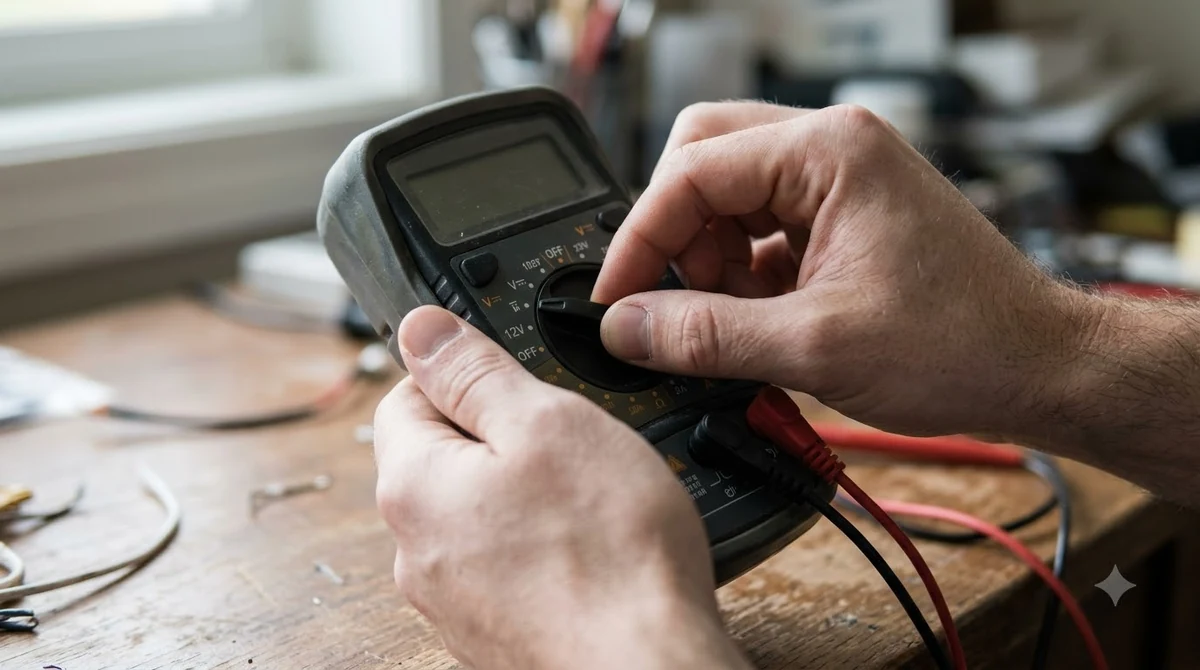
- Connect the COM lead first, then the live lead.
- Keep the red lead out of the 10 A jack unless you are measuring current.
- Check the meter fuse before any current measurement, as Fluke advises.
- Watch for the LEAd alert. The meter shows LEAd and beeps whenever the dial moves to or from an amp position.
When you finish, Fluke advises removing the live lead before the COM lead. When you learn how to use a digital multimeter, the Fluke 117 is auto-ranging by default, so it picks the range for best resolution. Press the range button for one second to switch to manual ranging. The meter shows a Z symbol when the input reaches 30 V or more.
Check Battery Voltage With the Engine Off
A fully charged 12 V lead-acid car battery reads about 12.6 V with accessories off, and a reading below 12.0 V means the battery is discharged. Here is how to use a digital multimeter on the battery itself: turn the dial to DC volts, then touch the red probe to the positive post and the black probe to the negative post. If your meter is manual-ranging, choose a range above 12 V. For a load test, follow battery testing instructions.

Turn off the accessories before you measure. If the car was just driven, run the headlights for about 1 minute and then switch them off to remove surface charge. Fluke’s battery guide lists the reference values below.
| Charge state | Resting voltage |
|---|---|
| Fully charged | About 12.6 V |
| About 75% | About 12.4 V |
| About 50% | About 12.2 V |
| Discharged | Below 12.0 V |
A resting reading shows the charge level, but not whether the battery can start the engine under load. A dedicated battery tester covers that separate check. Think of how to use a digital multimeter on a battery as the first step, not the whole check.
Check Charging Voltage With the Engine Running
With the engine running, a normal charging system reads about 13.7 V to 14.7 V at the battery, and any reading above 13.0 V shows the alternator is charging. Charging checks are the second half of how to use a digital multimeter on a car. Start the engine with the leads fully inserted, and keep your hands clear of the fan belt and other moving parts. The full procedure is in testing an alternator with a meter.
- With the engine off, record the resting voltage on DC volts.
- Read the voltage at the battery terminals and compare it with 13.7 V to 14.7 V.
If the reading stays low while the engine runs, check the alternator and the battery cable connections before you replace any part. The separate guide on car battery chargers covers charging equipment in more detail.
Test Continuity and Resistance
Continuity mode beeps when a wire or fuse path is closed, and the Fluke 117 beeps below 20 ohms and stays silent above 250 ohms. Turn off circuit power and discharge any high-voltage capacitors before you test. Continuity is the simplest test in how to use a digital multimeter. A simpler tool for live circuits is covered in using a test light on car wiring.
- Turn off circuit power, then set the dial to the continuity position.
- Touch one probe to each end of the wire or fuse.
- A steady beep means the path is closed. Silence means it is open.
- For an exact number, switch to the ohms function, which reads from 0.1 ohm to 40 megohms on the Fluke 117.
Keysight’s guide treats 10 ohms or less as an electrical short, so a fuse that reads close to zero is intact. The Fluke 117 user manual advises using the ohms function rather than continuity for the most accurate resistance readings.
How to Use a Digital Multimeter for Parasitic Draw
A parasitic draw is current that keeps flowing after the car is off, and Fluke treats under 50 mA as normal and over 100 mA as suspect. Measuring it means placing the meter in series with the battery, because Keysight describes current measurement as placing the meter in series with the circuit so the current flows through it. Fluke’s parasitic drain guide lists the steps below. A parasitic draw test is the most advanced part of how to use a digital multimeter on a car.
- Let the vehicle sit for 10 to 45 minutes with the engine off, accessories switched off, doors closed and interior lights off, so modules can enter sleep mode.
- Plug the black lead into COM and the red lead into the 10 A jack, then set the dial to DC amps.
- Disconnect the negative battery cable.
- Connect the red lead to the battery post and the black lead to the cable you removed, so all current flows through the meter.
- Read the draw. Under 50 mA is normal, and over 100 mA is suspect.
- If the draw is high, pull fuses one at a time. When the reading drops significantly, the circuit on that fuse is the likely source.
- Reconnect the battery carefully after testing to avoid triggering security systems.
Do not crank the engine or run high-current devices while the meter is in current mode. Fluke suggests moving to a mA jack once the draw falls below 400 mA, but the Fluke 117 has no mA jack, so its 10 A input and 1 mA maximum resolution set the limit. If you use a memory saver or fuse loop to keep settings, disconnect it during the actual current test. Practice how to use a digital multimeter on a known good car first, so the 10 A setup feels familiar before you test a suspect draw.
Common Mistakes That Cause Wrong or Unsafe Readings
The costliest errors are a lead in the wrong terminal, probing a circuit while the leads sit in the amp jacks, and cranking the engine in current mode. Each one can injure you or damage the meter. Many mistakes in how to use a digital multimeter come from the leads, not the dial.
- Leaving a lead in the wrong terminal, which Fluke says can cause personal injury or damage to the meter.
- Placing the probes in parallel with a circuit while the leads are in the A terminals.
- Cranking the engine or running high-current devices while the meter is in current mode.
- Opening the meter case or battery door while the test leads are still connected.
Quick Reference: Dial and Jack Settings
Use this table to match each car test with its dial position, input jack and typical reading. On the Fluke 117, every current test uses the 10 A jack. Keep this table handy the next time you learn how to use a digital multimeter on a car.
| Test | Dial setting | Jacks | Typical reading |
|---|---|---|---|
| Battery at rest | DC volts | COM and V | About 12.6 V when fully charged |
| Charging | DC volts, engine running | COM and V | 13.7 V to 14.7 V |
| Continuity | Continuity | COM and V | Beep below 20 ohms (Fluke 117) |
| Parasitic draw | DC amps | COM and 10 A | Under 50 mA is normal |
Other meters can add a separate mA jack for small draws, so check the input labels on your own meter before you connect the leads.
Frequently Asked Questions
Can a digital multimeter test a car battery?
Yes. Learning how to use a digital multimeter on a battery starts with DC volts: set the dial and read the resting voltage with accessories off. A fully charged 12 V lead-acid battery reads about 12.6 V, while a reading below 12.0 V means the battery is discharged. A resting reading does not show whether the battery can deliver current under load, so a load test is still needed.
Does the Fluke 117 have a milliamp jack?
No. Its input terminals are COM, V and 10 A, so learning how to use a digital multimeter for current on this model means the 10 A jack only. Its DC current range runs from 0.001 A to 10 A. Connect the leads in series with the circuit, and check the meter fuse first.
Can I measure voltage on a live circuit?
Yes, voltage is measured with the circuit energized, which is a basic part of how to use a digital multimeter. The Fluke 117 shows a Z symbol whenever the measured voltage is 30 V or higher. Keep the leads in COM and V, and never attempt to measure above 600 V, which Fluke says is not allowed.
What is a normal parasitic draw on a car?
When you learn how to use a digital multimeter for drain tests, Fluke’s guidance treats a draw under 50 mA as normal and over 100 mA as suspect. Measure after the car has sat for 10 to 45 minutes so the modules can enter sleep mode. A reading between 50 and 100 mA calls for a retest and a check of the owner’s manual for the specific figure.
What does the LEAd warning mean?
LEAd appears on the Fluke 117 display, with a beep, whenever the dial moves to or from any amp position. It reminds you to check that the leads are in the correct terminals, which is part of how to use a digital multimeter without errors.
Before you put the meter away after learning how to use a digital multimeter, return the dial to a voltage setting and unplug both leads. If a parasitic draw stays above 50 mA after you pull the suspect fuses, a shop with a current clamp is the next step.