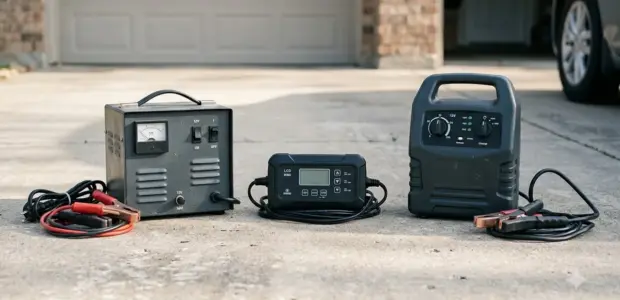

Knowing how to use a car battery charger means clamping it to the battery in the right order, with the charger switched off, and setting it to match your battery. The steps are simple, but the hydrogen gas a battery releases makes ventilation and the connection order matter.
A lower amp setting charges more slowly and is gentler on the battery. Check the battery label and the charger manual before you choose a setting.
This page explains how to use a car battery charger on standard lead-acid car batteries. If a battery is swollen, cracked or leaking, do not charge it, and follow both your charger manual and your vehicle manual.
Safety First: Hydrogen Gas and Ventilation
Car batteries release flammable hydrogen gas while they charge, so charge in a ventilated area with no open flames or sparks nearby. According to OSHA’s battery charging guidance, the gas can become explosive if it builds up in a closed space. A compact smart charger is explained in NOCO Genius 1 charge modes.
- Charge in a garage, shed or outdoor area with fresh air moving through it.
- Keep open flames, cigarettes, sparks and electrical arcs away from the battery.
- Keep your face away from the battery while you clip on the clamps.
Ventilation matters for the whole session, not just the first few minutes. If you are learning how to use a car battery charger for the first time, pick a spot with a door or window open and keep the battery away from fuel cans, solvents and workbench clutter.
Before You Connect: Check the Battery and Charger
Before you connect a charger, confirm that the battery voltage on its label matches the charger and that the charger supports your battery type. Read the charger manual first, because knowing how to use a car battery charger depends on settings that differ by brand. If the battery still seems dead after charging, checking circuits with a test light helps trace a power loss.
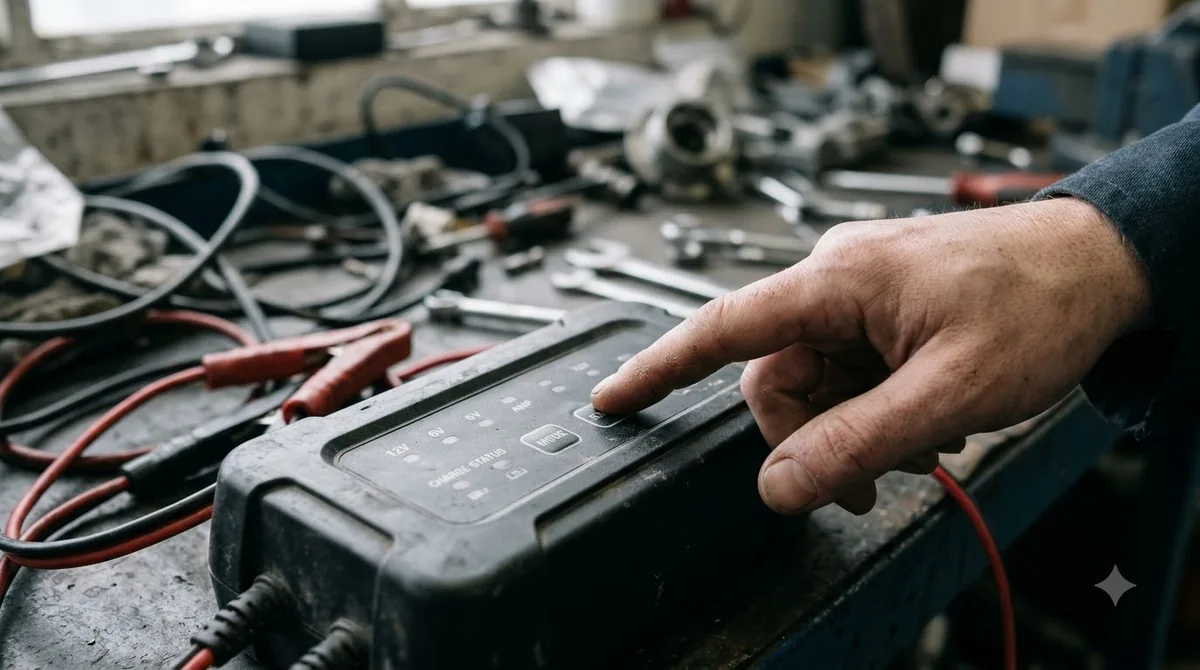
- Confirm the charger lists your battery type, such as standard lead-acid.
- Brush off any dirt or corrosion on the terminals so the clamps grip bare metal.
- Look over the clamps and cables for cracks or fraying before you start.
Some batteries have removable caps for topping up fluid. If yours does, check the fluid level and follow the manual before you connect anything. This quick check keeps the process simple, because knowing how to use a car battery charger starts with matching the charger to the battery in front of you.
How to Use a Car Battery Charger: Connect the Clamps in Order
Turn the charger off, clip the red clamp to the positive (+) terminal, and clip the black clamp to the negative (-) terminal. Follow this order every time you decide how to use a car battery charger.
- Turn the charger off and unplug it from the wall.
- Clip the red clamp to the positive (+) terminal, which is usually marked with a plus sign.
- Clip the black clamp to the negative (-) terminal, or to a metal ground point if your vehicle manual says so.
- Set the charger to match your battery type and the amp setting you chose.
- Plug the charger in, switch it on, and wait for it to finish. Turn it off and unplug it before you remove the clamps.
Sources disagree on where the black clamp should go, so check your vehicle manual before you clip it to a chassis point. When in doubt, keep the clamp away from the battery itself.
Connecting the black clamp last keeps any spark away from the battery itself. That is the main reason the clamp order matters when you learn how to use a car battery charger on a vehicle. Make sure each clamp grips bare metal and that the two clamps never touch, because a short between them can cause a spark.
Choose the Right Amps and Charge Setting
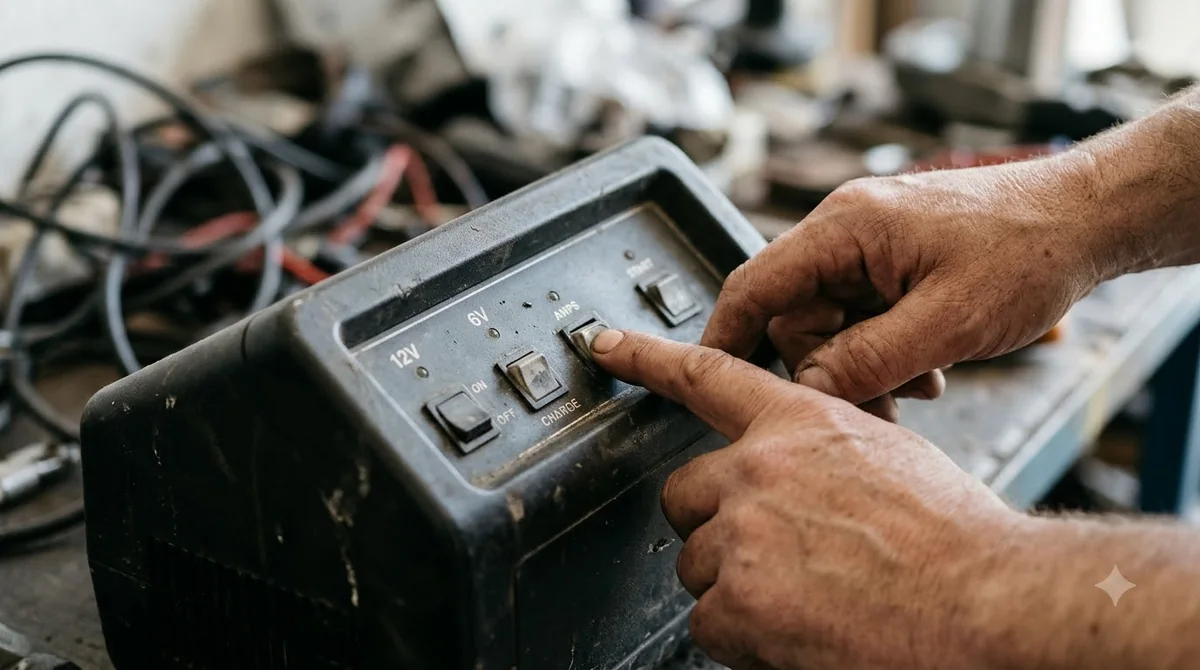
When you learn how to use a car battery charger, lower amps charge a battery more slowly and gently, while higher amps finish sooner but produce more heat. Match the setting to your battery and to how much time you have. A larger battery holds more charge to restore, so a small charger may take a long time on a big battery. When you need a quick start instead, see portable jump box instructions.
| Charger type | Best for | Charging speed |
|---|---|---|
| Standard manual charger | Recharging a drained battery | Faster at higher amps |
| Smart charger | Charging with automatic cut-off | Adjusts itself, check the manual |
| Trickle charger | Slow upkeep between uses | Slowest, low steady current |
| Battery maintainer | A car that sits for long periods | Slow, keeps the battery topped up |
Use the table as a starting point when you decide how to use a car battery charger, then confirm the setting in your charger manual. The battery label and the manual give the final answer for your specific model.
How Long Does It Take to Charge a Car Battery?
Charge time depends on the battery size, how drained it is and the amp setting you use when you learn how to use a car battery charger, so check your charger manual for an estimate. A battery that is nearly empty needs far longer than one that is partly charged.
- Battery size, shown as amp-hours on the label
- How drained the battery is when you start
- The amp setting on your charger
- Battery age and condition, since an older battery may take longer
The manual’s estimate is the best guide, since the charger knows its own output. Reading that estimate before you plug in is part of how to use a car battery charger well, and it helps you plan around the time you have.
How to Use a Trickle Charger for Battery Upkeep
A trickle charger supplies a low, steady current that offsets slow self-discharge when a car sits unused for weeks. Use it for upkeep rather than for quickly recharging a dead battery.
- Some older trickle chargers have no automatic shutoff, so check the manual before leaving one connected overnight.
- A smart charger or maintainer monitors the battery and adjusts its output on its own.
If a car will sit through the winter, connect the maintainer before you leave and route the cable so it does not rub against moving parts or sharp edges. Check the cable and clamps again when you return to the car.
Check the Charge and Avoid Common Mistakes
After charging, a multimeter reading shows whether the battery is holding its voltage. Use a digital multimeter across the terminals with the charger disconnected and the engine off, then compare the reading with the battery label or the manual. Test the result with checking battery health with a tester.
Do not judge the battery from a reading taken seconds after the charger comes off. Let it settle, then check again. Testing the battery after charging is part of how to use a car battery charger properly, not an extra step.
- Clipping a clamp to the wrong terminal, which reverses the polarity
- Skipping ventilation in a closed room
- Charging a battery that is swollen, cracked or leaking
- Connecting or removing clamps while the charger is still plugged in and switched on
All of these mistakes are easy to avoid when you learn how to use a car battery charger with a short checklist before you plug in: the manual, the clamp order, the ventilation and the amp setting.
Frequently Asked Questions
Which way do the clamps go on a car battery?
Attach the red clamp to the positive (+) terminal first, then attach the black clamp to the negative (-) terminal. OSHA guidance describes this same order, with the charger turned off before any clamp is connected.
Can I leave a car battery charger connected overnight?
It depends on the charger. Smart chargers with an automatic maintenance mode are designed for longer connection, while older chargers may need supervision. Check your charger manual before you leave it connected.
Is it safe to charge a car battery in a garage?
Yes, when the garage has fresh air and no open flames or sparks nearby. Hydrogen gas can build up in a closed space, so open a door or window while the charger runs.
Which amp setting should I use?
Choose a lower amp setting when you have time, because slower charging is gentler on the battery. Use a higher setting only when your charger manual and battery label allow it.
How do I know when the battery is fully charged?
Turn the charger off, disconnect it, and check the voltage with a multimeter. Compare the reading with the battery label or the manual, since the right value depends on the battery.
Do I need to disconnect the battery from the car?
Check your vehicle manual before charging. Some vehicles have electronics that need specific steps, so follow the owner’s guidance for your model.
Is it hard to learn how to use a car battery charger?
No. The steps are short: check the charger, clip the red clamp, clip the black clamp, set the amps, then switch on. The safety steps matter more than speed, so take the time to follow each one.
Can I use a car battery charger on a lithium battery?
Not every charger supports lithium batteries. Check the charger manual before you connect it to any other battery type, and use only a charger that lists support for that chemistry.
Knowing how to use a car battery charger is straightforward when you respect the hydrogen gas, follow the clamp order and match the amps to your battery. If a battery will not hold a charge after a full cycle, have it tested by a shop before you keep trying, because a failing battery can be a risk.